BOO-TOX FOR HEADACHES
Written by: Dr. Niralee Rana
Edited by: Dr. Joann Hsu
Case:
In the ED, you see a 41-year-old female with past medical history of right sided Bell’s Palsy, presenting with left sided occipital headache for the past 2 days. Her Bell’s Palsy 1 year ago was preceded by an occipital headache, and caused chronic R sided facial weakness. The patient was concerned her headache now would cause another episode. She has followed up with a neurologist and had negative MRI results in the past year.
Along with the headache she endorses photosensitivity, but denies auras, dizziness, vision changes, hearing loss, any weakness, nausea, vomiting, or recent tick exposures.
She is worked up for occipital headache vs tension headache vs muscle spasms because physical examination showed no acute weakness to suggest early Bell’s Palsy. She was provided tylenol, robaxin, and reglan for symptomatic relief and offered an occipital nerve block.
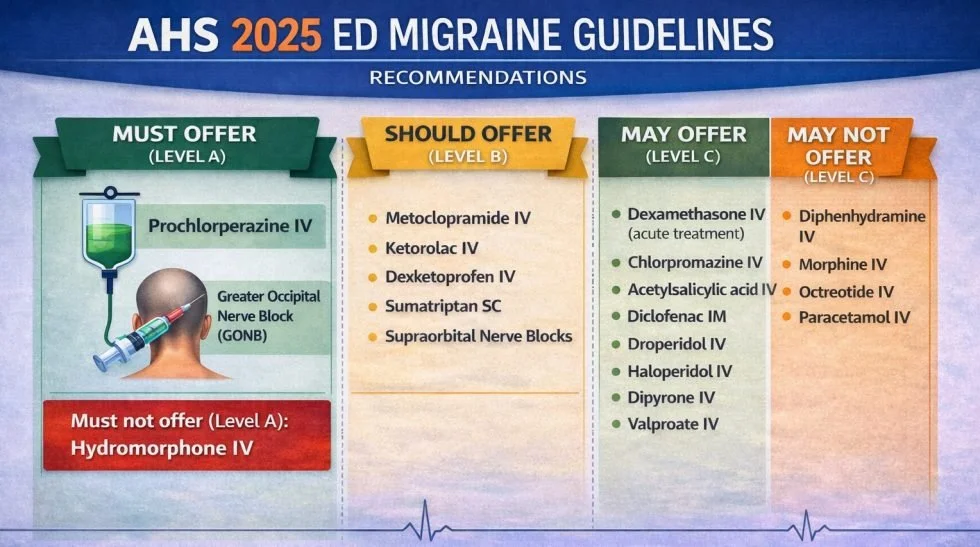
According to the AHS 2025 ED migraine guidelines, level A treatment for headaches includes Compazine IV and greater occipital nerve blocks (GONB).
Indications of greater occipital nerve blocks include:
Refractory migraines
Cluster headaches
Occipital neuralgia
Cervicogenic headaches
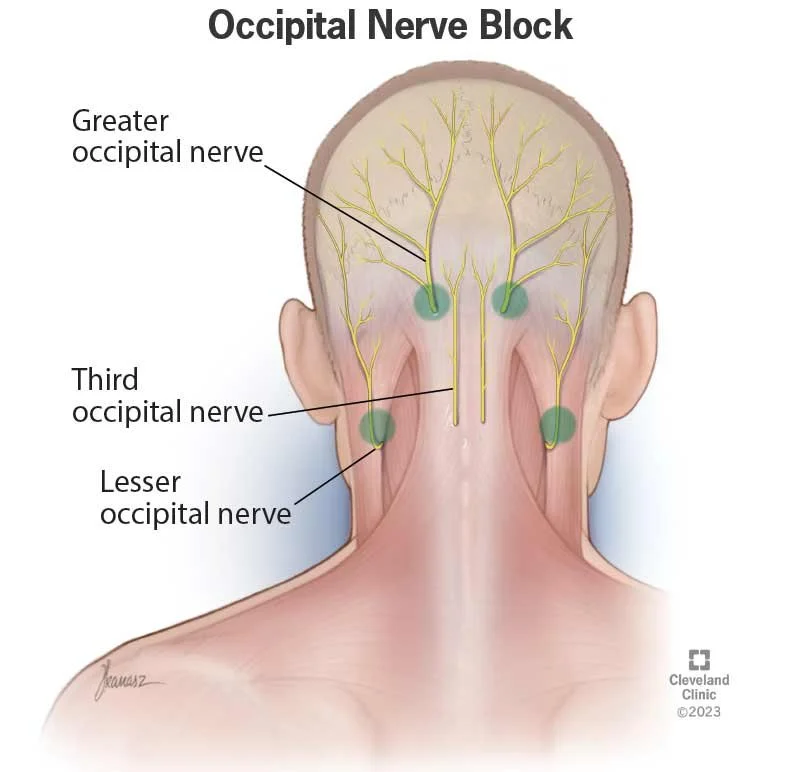
Upon physical examination, if a patient had reproducible pain upon palpation of the greater occipital nerve, they may be a good candidate for GONB because these conditions tend to be caused by entrapment of one of the three branches of the occipital nerve, the greater branch.
Absolute and relative contraindications of GONBs are similar to those for any nerve block.
Skull fractures
Overylying infections
Allergies to local anesthetics
Coagulopathies
Pregnancy
Hemodynamic instability.
Positioning
When performing a GONB, patients tend to be prone.
If they cannot tolerate lying on their stomach, they should be seated with their head slightly flexed.
GONBs can be done landmark based or ultrasound guided.
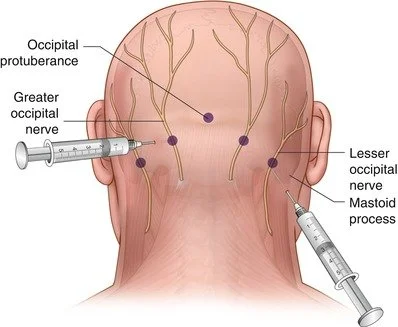
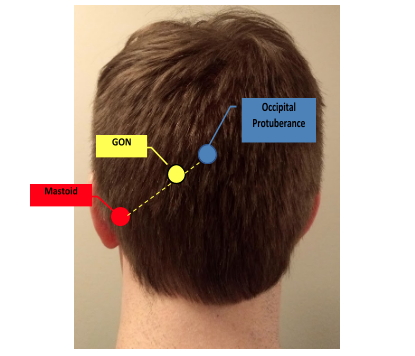
The landmark approach is palpating for occipital protuberance and mastoid process, forming a diagonal line and injecting in between the landmarks.
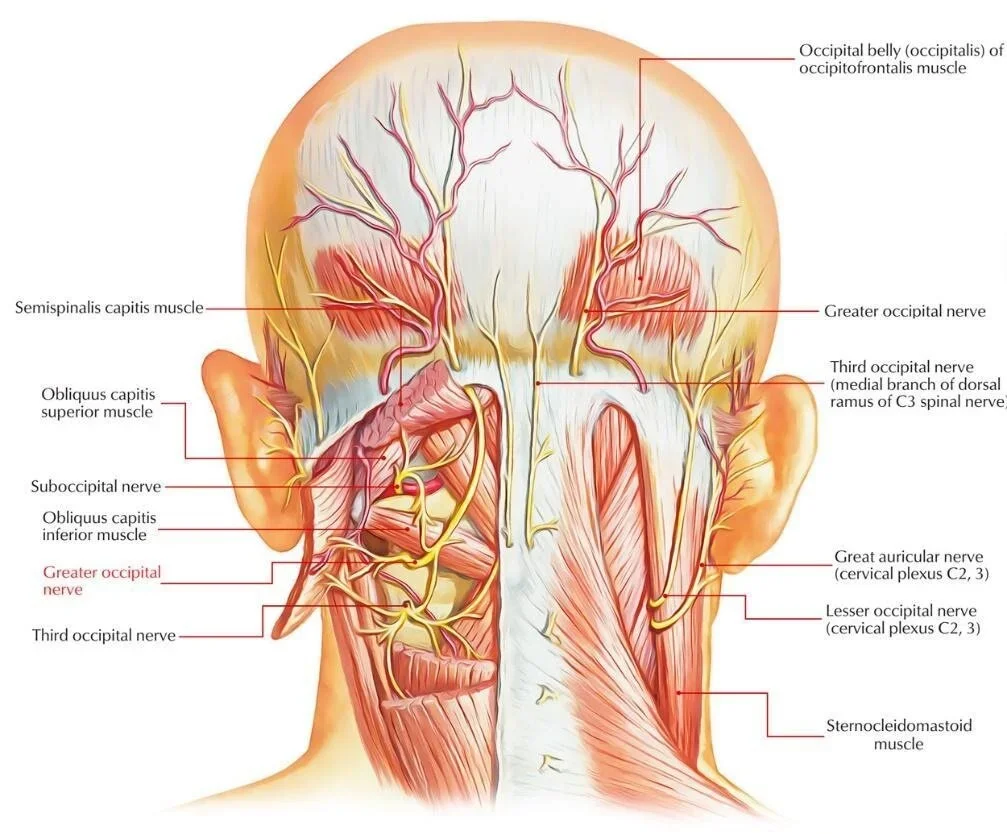
Compared to the landmark approach, ultrasound guidance allows you to visualize the muscles you want to target (the semispinalis capitis and the obliquus capitis inferior) and the vessels you want to avoid (occipital artery and vein).
Overall this gives you better success because allows you to inject more proximally up the greater branch of the occipital nerve closer to the spinous process of C2
The procedure
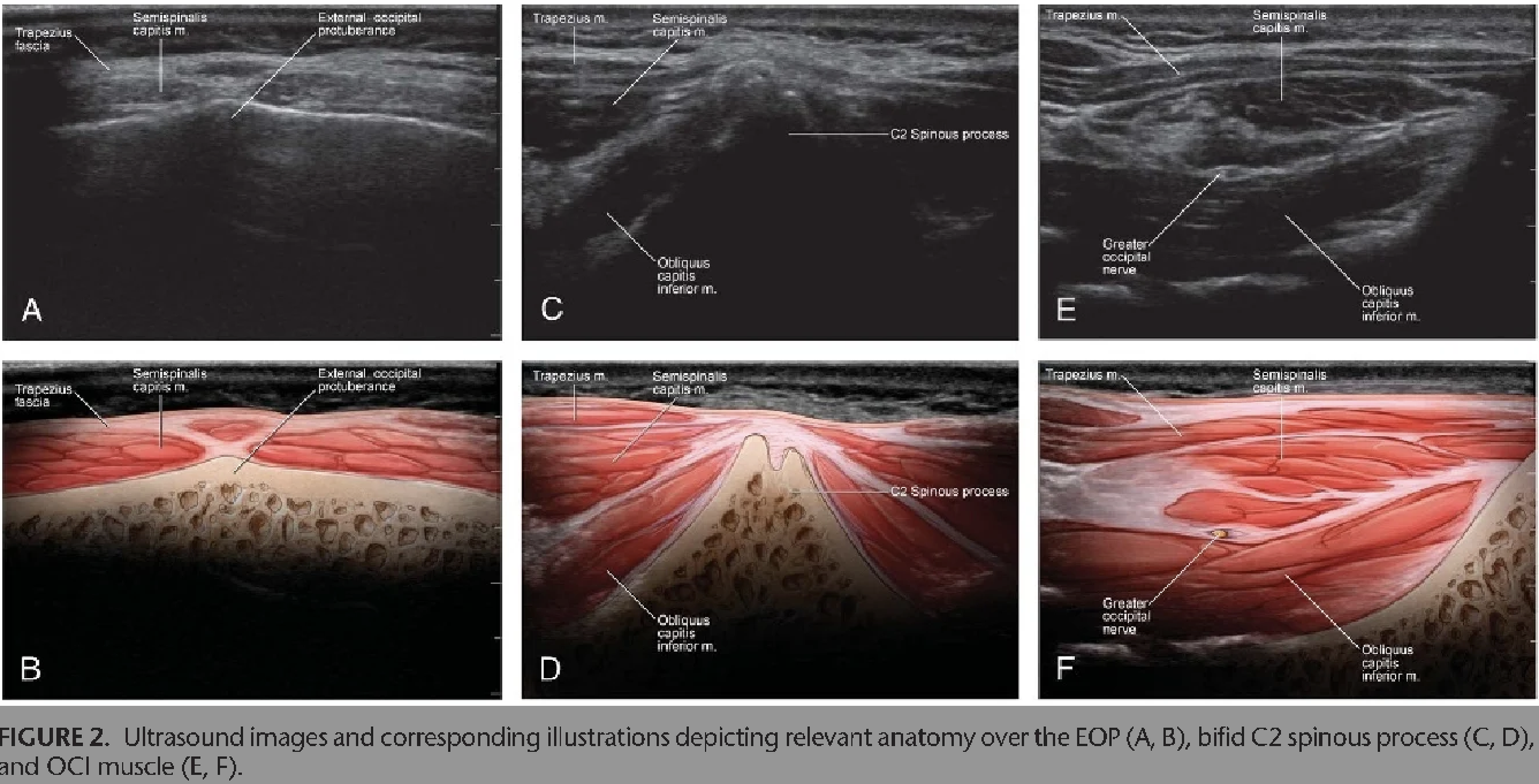
Once you’ve set up the patient prone, use linear probe to start the occipital protuberance.
You will most likely be scanning and injecting in an area of a lot of hair so make sure to clean thoroughly and pull as much hair to the side as possible (with assistance).
Move caudally until you see the bifid spinous process of C2 in the middle of your screen.
Move inferolaterally towards the patient’s ear until you visualize the obliquus capitis inferior muscle.
Turn the probe so that the lateral part of the probe is inferior to the medial part.
This should help bring the semispinalis capitis and sometimes the trapezius muscle into view.
The semispinalis capitis muscle will be superficial to the GON pocket and more hyperechoic then the obliquus capitis inferior muscle which also helps differentiate them.
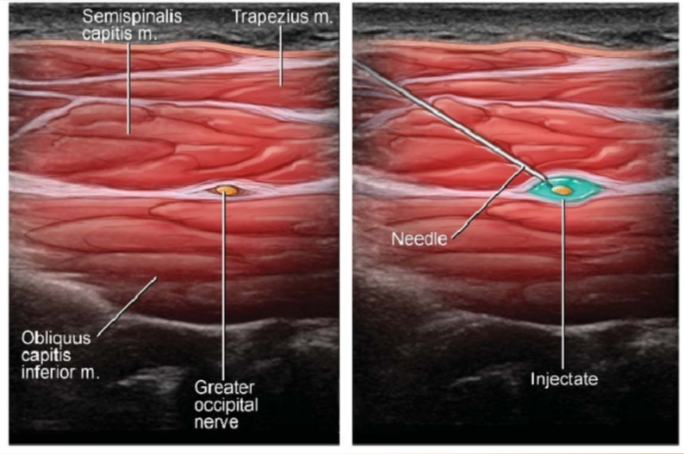
Once you’ve visualized all of the following: semispinalis capitis, obliquus capitis inferior, greater occipital nerve, occipital artery, you’re ready to advance your needle in plane until you are between the two muscle bellies.
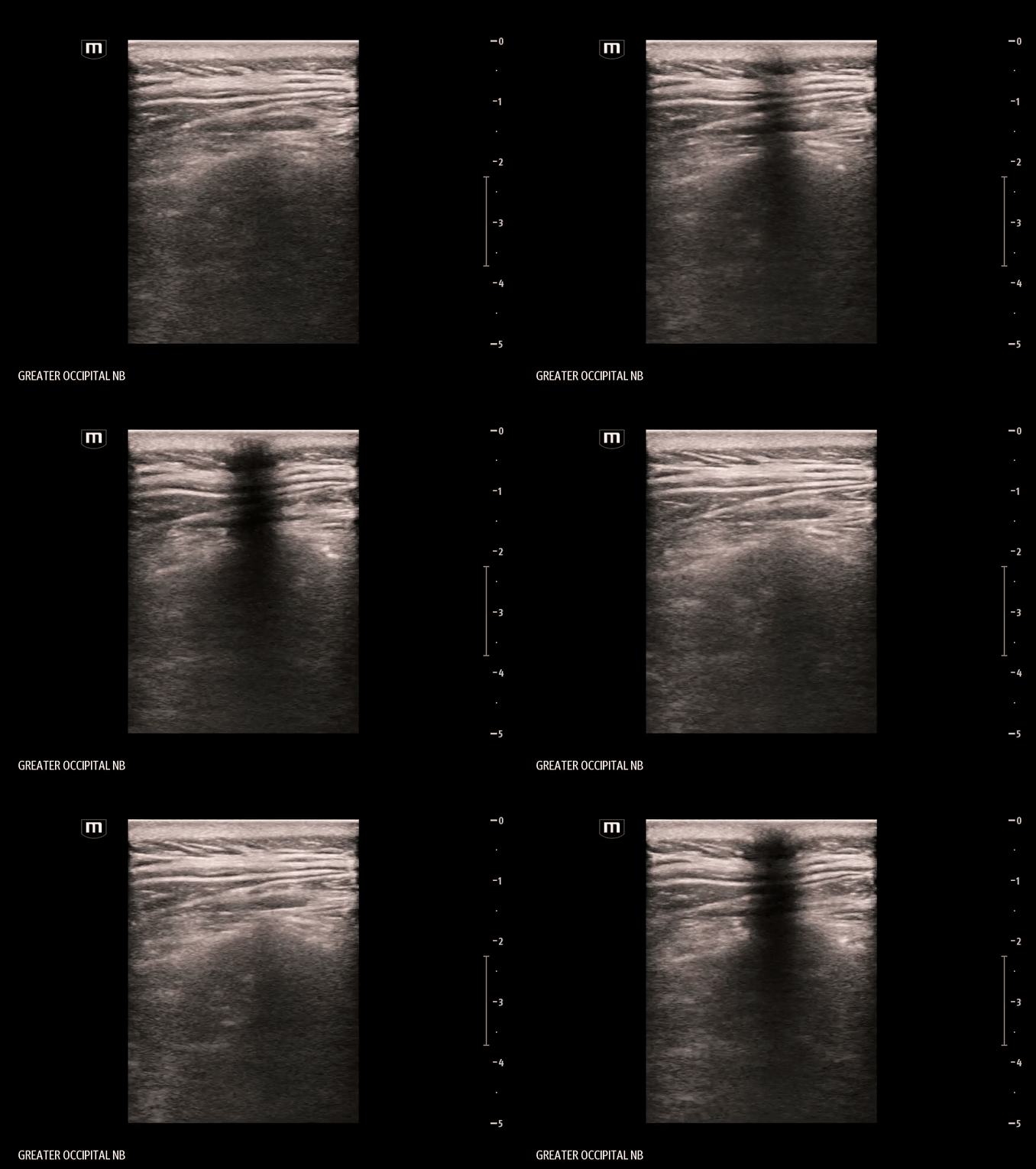
After negative aspiration, and injecting a test dose to see proper scissoring apart of the muscles, inject half of your dose of 1% lidocaine.
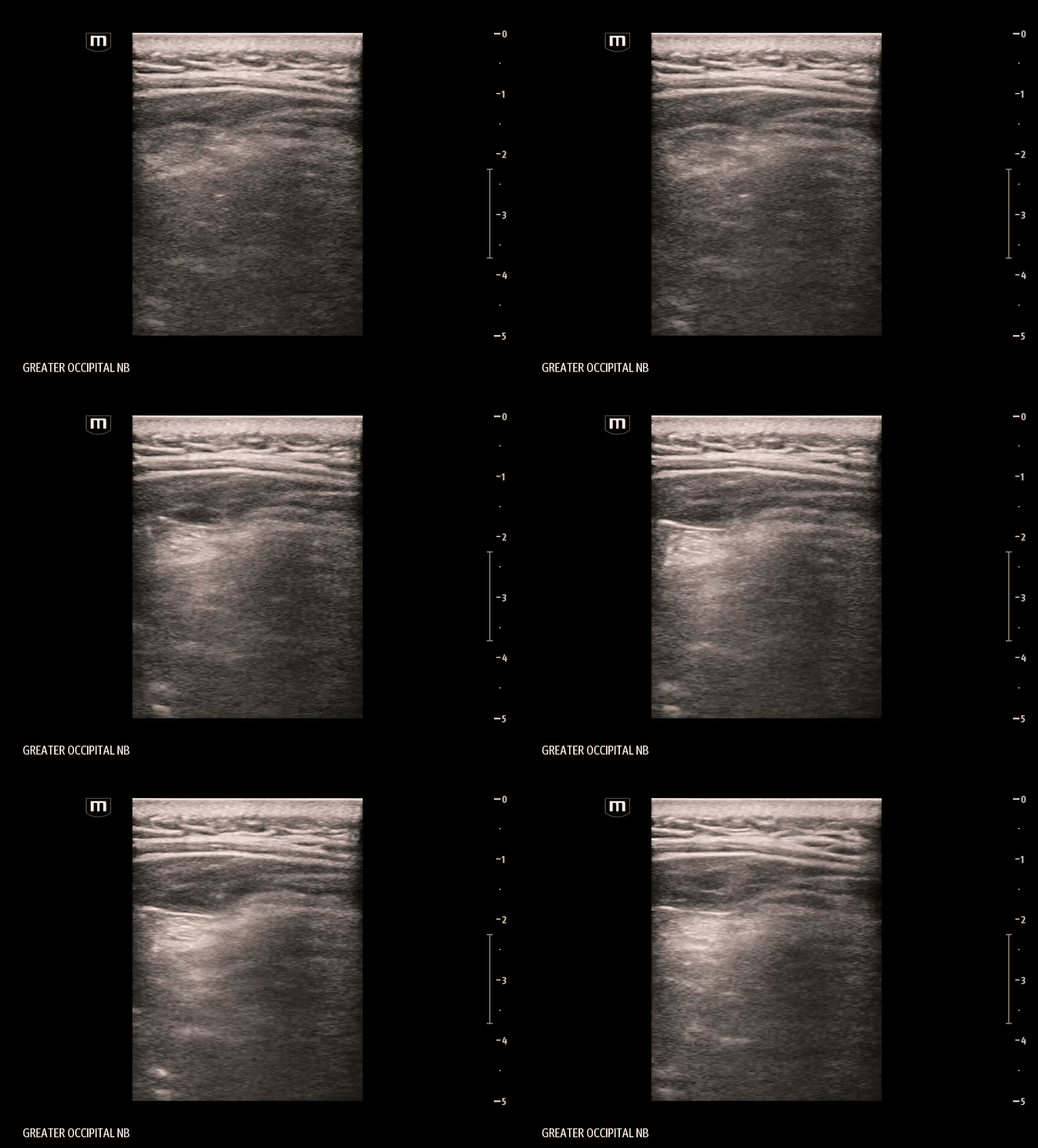
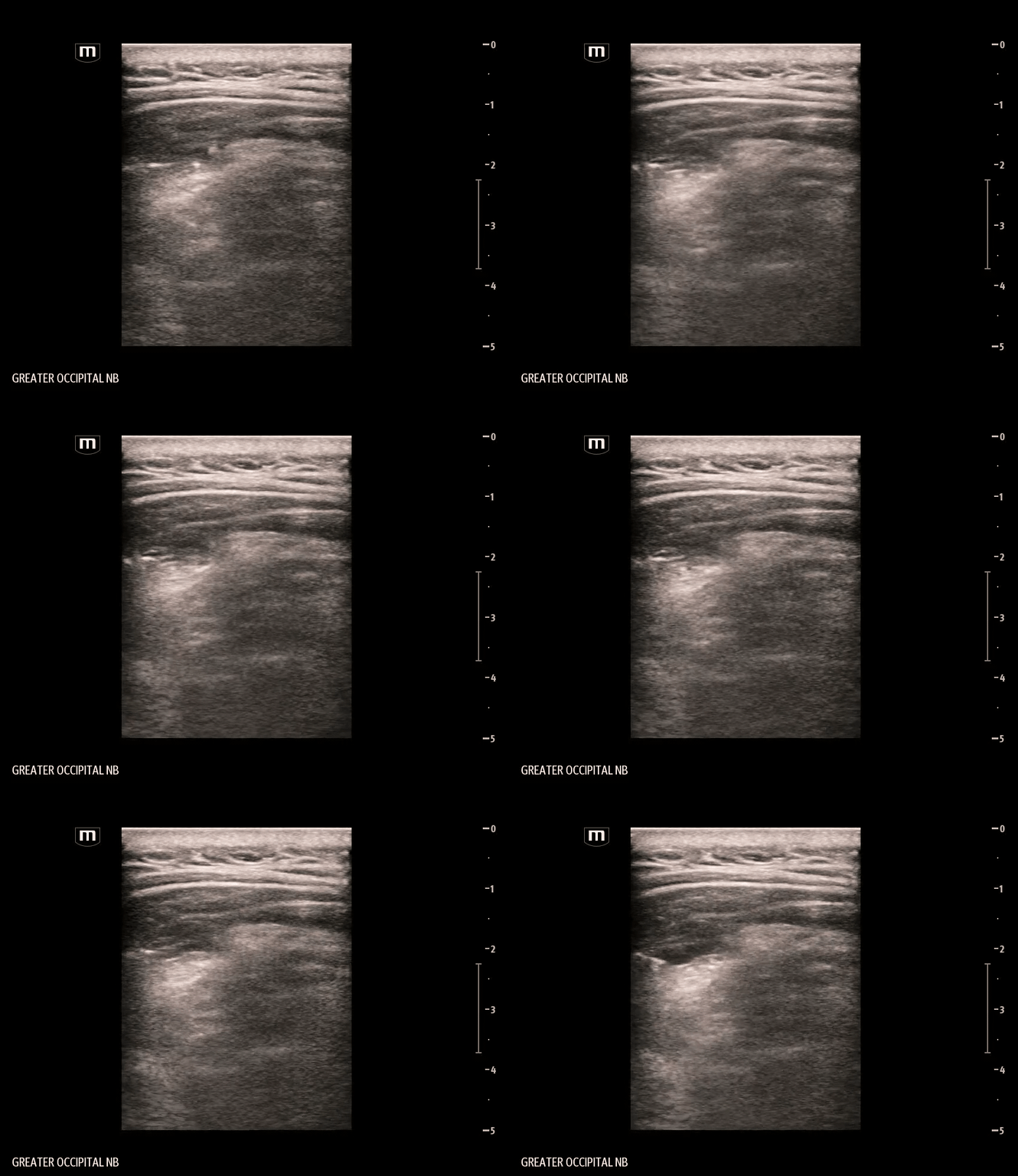
Our patient received 50mg of 1% lido on one side, but this block is typically done bilaterally which is why you split the dose for each side. Remember to monitor your patient’s vitals throughout and after the procedure!
Some key points are:
Consider ultrasound guided nerve block for the treatment of posterior headache
Remember to scan from the occipital protuberance down to C2 and that infero-lateral to OCIM + SSCM
Remember to perform negative aspiration, test dose, and then full doses of medication
Consider bilateral blocks for maximum effectiveness.
Happy scanning!