
The RAMER Reviews: Does the Airway Device Change the Meaning of ETCO₂?
Written By: Andrew Shanes, DO; Edited By: Brian Smith, DO, MA, MMSc-Med
Introduction
Rising end-tidal carbon dioxide (ETCO₂) during cardiac arrest can signal improving circulation. Whether airway device type changes the relationship between that trend and clinical outcomes is less clear.
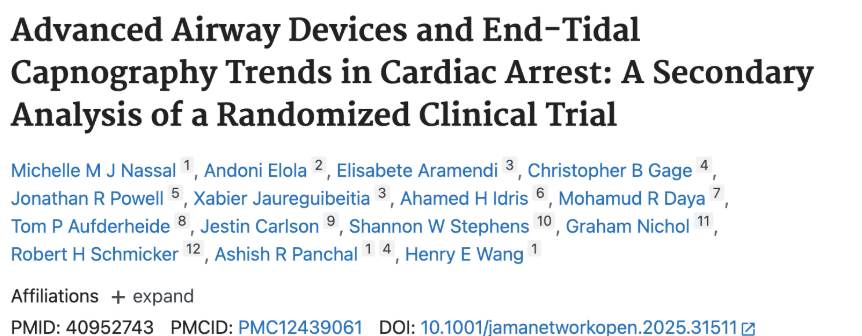
Nassal and colleagues examined this question using the Pragmatic Airway Resuscitation Trial (PART), which compared 72-hour survival after initial laryngeal tube placement versus endotracheal intubation. Rising ETCO₂ was associated with return of spontaneous circulation (ROSC) with both devices, but an apparent difference between devices was not supported when patients were analyzed by randomized assignment.
What Did They Do?
This was a post hoc analysis of the Pragmatic Airway Resuscitation Trial (PART), a cluster-crossover randomized trial involving 27 EMS agencies in five North American communities. Before patient enrollment, agencies were grouped into 13 clusters and randomized to initial airway strategies, with crossover at predetermined three- to five-month intervals. Rescue devices were also permitted.
The analysis included 1,113 adults with nontraumatic out-of-hospital cardiac arrest, successful advanced airway placement, and usable capnography: 818 laryngeal tubes and 295 endotracheal tubes. The initial trial excluded children, pregnant patients, prisoners, and traumatic arrests. Additional exclusions included unavailable CPR process files, absent or uninterpretable ETCO₂ recordings, and no advanced airway.
They examined minute-by-minute ETCO₂ trajectories and associations with sustained ROSC and 72-hour survival. The primary analysis grouped patients by their last successfully placed airway device, rather than their original randomized assignment.
Analyses used Mann–Whitney tests, the Cochran–Armitage trend test, and logistic regression adjusting for patient and arrest characteristics, airway device, ETCO₂ slope, and their interaction. Sensitivity analyses accounted for clustering and regrouped patients by randomized assignment.
What Did They Find?
Individual ETCO₂ measurements did not differ significantly between devices. Increasing ETCO₂ was associated with ROSC in both groups.
In the as-treated analysis, the association between ETCO₂ slope and ROSC was stronger with endotracheal tubes:

The airway-by-slope interaction was significant for ROSC (P = .001), but not 72-hour survival (P = .20), only describing associations within each group, not that intubation improves ROSC.
When grouped by randomized assignment, the slope–ROSC associations were similar: OR 1.45 for laryngeal tube versus 1.41 for intubation, with both confidence intervals excluding 1. The authors reported that the device-specific difference no longer persisted.
Why Does the Sensitivity Analysis Matter?
Consider two patients assigned to intubation. One is successfully intubated immediately. The other has failed attempts before receiving a rescue laryngeal tube.
Grouping them by final device places these patients in different categories, even though both started with the same assigned strategy. The comparison can therefore reflect the difficulty and course of the resuscitation alongside any effect of the device.
The sensitivity analysis weakens a device-specific explanation. The association between rising ETCO₂ and ROSC persisted, but the device-specific difference was not supported in the analysis by randomized assignment.
The odds ratios also require careful interpretation. They describe the association between ETCO₂ slope and ROSC within each group. They do not mean intubation doubles the chance of ROSC compared with a laryngeal tube.
What Makes This Study Useful?
Continuous waveform analysis evaluates how ETCO₂ changes during resuscitation rather than relying on a single measurement. That distinction matters when interpreting a monitor at the bedside. These trajectories provide information about the association between changes in ETCO₂ and resuscitation outcomes.
The sensitivity analysis is another strength. Repeating the analysis by randomized assignment tests whether the apparent device difference persists when patients remain in their original treatment groups.
What Limits the Findings?
Selection may affect the results. Only 37.1% of the original PART cohort entered this analysis. Patients with successful airway placement and usable recordings may differ from those excluded.
Association does not establish a treatment target. Rising ETCO₂ may accompany improving physiology without proving that interventions aimed at increasing the number improve outcomes. This study does not establish that “chasing the ETCO₂” benefits patients.
A nonsignificant difference does not establish equivalence. Similar measurements do not prove that two devices provide equivalent ventilation or clinical outcomes.
The device comparison has boundaries. Findings involving a laryngeal tube cannot automatically be extended to every supraglottic airway, including the i-gel.
ROSC is an intermediate outcome. An association with ROSC does not establish improved survival with meaningful neurologic recovery.
What Does This Change in Practice?
These results support the usefulness of ETCO₂ trends with either studied device, while providing little justification for changing airway strategy based on capnography alone.
The study did not test whether exchanging an airway improves outcomes, establish device-specific ETCO₂ thresholds, or validate a rule for terminating resuscitation.
For a patient arriving with a functioning laryngeal tube, this paper does not establish that exchanging it for an endotracheal tube improves capnography interpretation or clinical outcomes.
ETCO₂ trajectories should be interpreted alongside the resuscitation. The observed associations do not establish an indication for airway exchange.
Reference
Nassal MMJ, Elola A, Aramendi E, et al. Advanced airway devices and end-tidal capnography trends in cardiac arrest: a secondary analysis of a randomized clinical trial. JAMA Netw Open. 2025;8(9). doi:10.1001/jamanetworkopen.2025.31511