
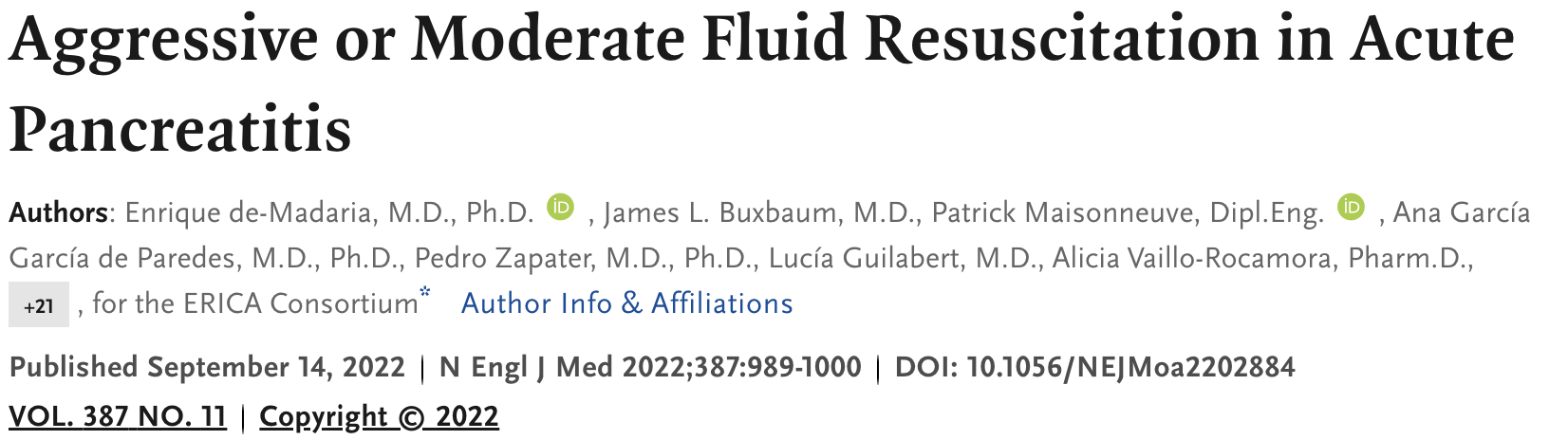
The RAMER Reviews: WATERFALL Trial - Aggressive or moderate fluid resuscitation in acute pancreatitis
Written By; Justin Song, DO; Edited By: Brian Smith, DO, MA, MMSc-Med
1. What was the study question?
In adults with early acute pancreatitis, does aggressive IV fluid resuscitation reduce progression
to moderately severe or severe disease compared with moderate, goal-directed fluids?
2. What was the study design?
Multicenter, open-label, randomized controlled trial (RCT).
3. What was the exposure/intervention?
Participants were divided into two treatment arms: aggressive fluid resuscitation (20 mL/kg LR
bolus, then 3 mL/kg/hr) versus moderate fluid resuscitation (10 mL/kg bolus only if hypovolemic,
then 1.5 mL/kg/hr; no bolus if normovolemic). Fluids were reassessed and adjusted.
4. How was the outcome defined?
The primary outcome of the study examined whether patients developed moderately-severe or
severe acute pancreatitis. The main safety outcome studied if patients became clinically fluid
overloaded using predefined criteria.
5. How were participants recruited?
Adults presenting with acute pancreatitis at multiple centers were screened and enrolled early in
the course of their illness.
6. What were the inclusion criteria?
Adults with acute pancreatitis enrolled within 24 hours of presentation and within 8 hours of
diagnosis, without moderately severe/severe disease at baseline.
7. What were the exclusion criteria?
Included exclusion criteria were severe pancreatitis at baseline and important comorbidities that
would increase fluid risk or complicate assessment, such as heart failure and chronic renal
failure.
8. Was randomization used?
Yes. Participants were randomized to aggressive or moderate fluid protocols, reducing selection
bias and supporting comparison of outcomes.
9. Was sample size/power adequate?
The planned sample was 744, but the trial stopped early after 249 participants because of
safety concerns. Early stopping limited precision and the ability to detect differences in less
common outcomes.
10. Were baseline groups comparable?
Randomization produced generally comparable groups between the two treatment arms
11. What statistical methods were used? Was intention-to-treat used?
The study used Student’s t-test or Mann–Whitney U test for continuous variables and chi-square
or Fisher’s exact test for categorical variables, reporting relative risks with 95% confidence
intervals. Missing data were assessed using complete-case and multiple-imputation analyses,
with additional adjusted analyses using the Cochran–Mantel–Haenszel method. An
intention-to-treat analysis was performed, including all randomized patients in their assigned
groups.
12. What were the main results?
The study found the progression to moderately severe/severe pancreatitis was 22.1% with
aggressive fluids vs 17.3% with moderate fluids. In terms of safety outcomes, researchers found
patients became fluid overloaded 20.5% vs 6.3% respectively.
13. Were the results statistically significant?
The primary outcome was not significant (adjusted RR 1.30; 95% CI 0.78–2.18; P=0.32). Fluid
overload was significantly more common with aggressive fluids (adjusted RR 2.85; 95% CI
1.36–5.94; P=0.004)
14. Were the results clinically significant?
Yes for safety: the absolute increase in fluid overload was 14.2 percentage points, roughly one
additional case for every 7 patients treated aggressively. No clinical benefit of aggressive fluids
was demonstrated.
15. What were the main limitations/biases?
Open-label treatment could influence clinical decisions and outcome assessment. Early
termination and a smaller-than-planned sample reduced precision. Exclusions limit applicability
to patients with severe disease or major cardiac/renal comorbidity.
16. What design-specific biases were relevant, and how were they addressed?
Open-label design creates potential performance and detection bias; standardized protocols
and predefined outcomes help, but cannot eliminate it. Randomization reduces confounding.
The independent safety monitoring process identified excess fluid overload and prompted early
stopping.
17. Was internal validity strong?
Moderately strong because of randomization, multicenter enrollment, and standardized
protocols. Confidence is tempered by the open-label design and early stopping.
18. Was external validity strong? How should practice change?
Findings apply best to adults with early acute pancreatitis who resemble enrolled patients. Use
moderate, goal-directed fluids with frequent reassessment rather than routine aggressive
hydration; individualize care for shock, severe disease, heart failure, or renal impairment.
19. How does this fit with current knowledge?
It challenges the traditional assumption that aggressive early fluids are broadly beneficial. It
supports a tailored approach: correct hypovolemia, monitor response, and avoid fluid overload
rather than using a fixed aggressive regimen for everyone