
The RAMER Reviews: The Peach Trial: Not so peachy?
Written By: Sabrina Lee, DO; Edited By: Brian Smith, DO, MA, MMSc-Med
Introduction
Intracranial hemorrhage (ICH) accounts for approximately 10-15% of all strokes. Additionally, about 30% of all stroke patients experience an early seizure within 7 days of being diagnosed with a stroke. Notably, the majority of these seizures are subclinical and seen on vEEG. Furthermore, there is not enough evidence to determine if these subclinical seizures truly affect morbidity and mortality in the long term.
There is limited guidelines and recommendations for using anti-seizure medications, such as levatiracetam, in preventing seizures in patient with spontaneous intracranial hemorrhage. Levatiracetam is often the drug of choice for seizure prevention in intracranial hemorrhage, traumatic brain injuries, and subarachnoid hemorrhage.
1.What is the study question?
Does primary prophylaxis with levetiracetam, compared with a placebo, lower the risk of early clinical or subclinical seizures in adults (age 18 years old and older) with acute spontaneous supratentorial intracranial hemorrhage (ICH)?
2. What study design is used to answer the question?
A phase 3 trial that was parallel-group, double-blinded, placebo-controlled, and randomized. It took place at three stroke centers in France.
3.. What is the exposure or intervention?
IV levetiracetam 500mg every 12 hours for 2 days → then 500 mg PO every 12 hours for 30 days → then a taper for 2-weeks. Placebo group had a matching regimen.
4, What is the outcome (or disease) and how is it measured (or defined)?
Primary:
Occurrence of at least one clinical or subclinical seizure seen on continuous EEG within 72 hours after inclusion into the study
Secondary:
Number of seizures recorded on continuous EEG
Total duration of seizures recorded on continuous EEG
Number of clinical seizures within 72 hours and early (day 0 to day 30) and late (day 30 to 12 months) clinical seizures
Change in NIHSS scores between inclusion and 72 hours, 1 month, and 3 months
Change in modified Rankin Scale (mRS) scores between inclusion and 3 months, 6 months, and 12 months
Stroke Impact Scale was used to assess quality of life at 3 months, 6 months, and 12 months
Change in intracerebral hemorrhage volume and mass effect defined as midline shift at 72 hours
5. How were participants selected or recruited for the study?
Patients were enrolled in consecutive presentations among the three sites. Patients were given written consent when able; otherwise, a proxy consented and the patient later consented. Enrollment was a convenience sample of patients seen at the 3 centers, not population-based.
6. Who was included in the study?
Patients who were:
Age 18 years or older
CTH or MRI confirmed spontaneous supratentorial ICH
Presentation within 24 hours of symptom onset
7. Who was excluded from the study?
Exclusion Criteria
NIHSS > 25
ICH that was known or suspected to be secondary to trauma, vascular malformation, hemorrhagic transformation of ischemic stroke, or tumor
Current antiseizure drugs or a history of epilepsy
Pregnancy or breastfeeding
Severe depression or psychosis
Terminal illness
Levetiracetam allergy
Occurrence of a seizure between inclusion and start of treatment
8. If randomization occurred at what point did it occur?
Randomization occurred at inclusion, before the treatment started, and before continuous EEG began. A web-based system was used, which was stratified by each center and baseline NIHSS. Patients who had a seizure between inclusion and treatment were also excluded.
9. What do the authors say about power/sample size of the study? Is the power adequate to answer the study question?
The anticipated enrollment was 104 participants, as the researchers determined that this sample size would provide adequate power. However, the recruitment stopped at almost half of the target enrollment due to slow enrollment and lack of funding with the COVID pandemic. Thus, the study ultimately had 50 randomized enrolled participants and 42 in the analysis. The power of this study was not adequate.
10. Are the study groups’ characteristics comparable at baseline?
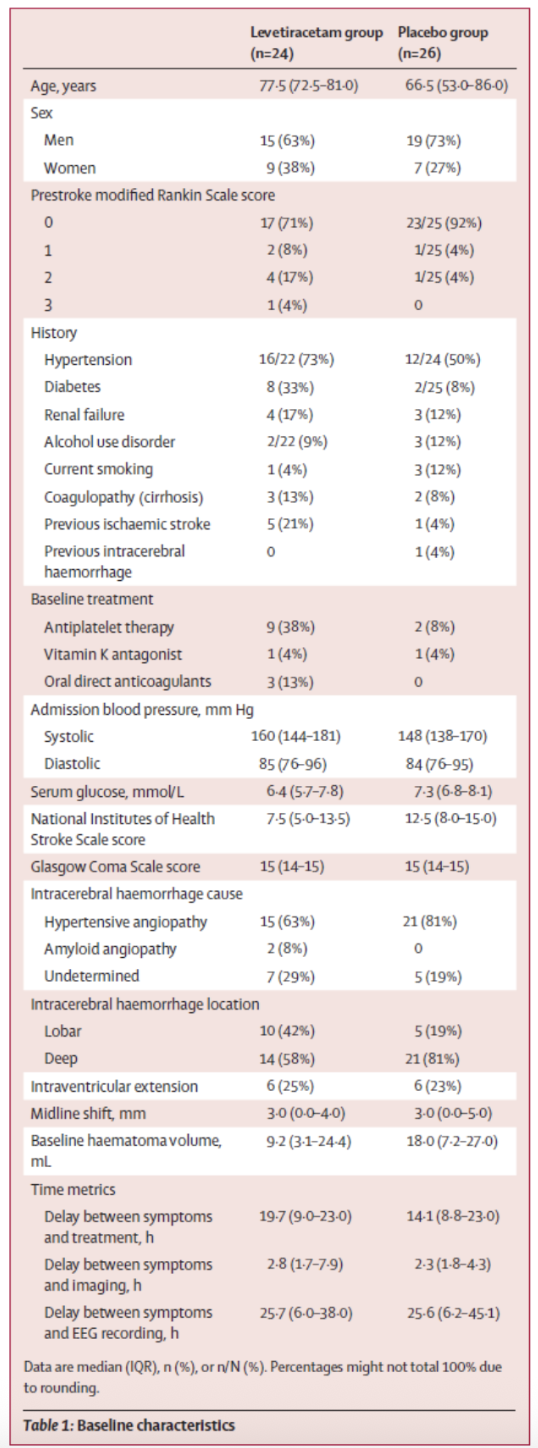
The groups were not well balanced, which is possibly due to the small sample size. Most notably, the NIHSS and the hematoma volume size was larger in the placebo group compared to the levetiracetam group. This might contribute to their findings of seeing a statistically significant more subclinical seizures in the placebo group than the levetiracetam group.
11. What are the results of the study?
It’s important to note that this study ended early due to the COVID pandemic and lack of funding.
For the primary outcome, the study found a barely statistically significant difference (p = 0.043 and CI 0.03 to 0.94) in seizure occurrence between the two groups. They found seizures in 3 out of 19 (16%) of patients in the levetiracetam group and 10 out of 23 (43%) of patients in the placebo group. However, to note, all of the seizures documented were all subclinical. Among secondary outcomes, there were no other statistically significant findings.
12. Are the results clinically significant?
Not quite…. The difference that this study found was only on subclinical seizures seen only on vEEG. The effect of subclinical seizures on patient’s prognosis after ICH is still uncertain with limited data. Thus the question is: Even if the occurrence of subclinical seizures was statistically significant with a difference favoring the levetiracetam group, does it really matter? Additionally, the occurrence of clinical seizures, disability, and quality of life did not particularly improve.
13. What are the biases/limitations of the study that could cause you to question the author’s conclusions?
Some limitations of the study included:
Early end to the study affected its sample size and power. This could either inflate or deflate the significant results. The researchers do note that because of this, there should be caution with interpretation of the results.
Imbalance in baseline characteristics between the groups. Most notably, the NIHSS and hematoma volume size were higher in the placebo group compared to the levetiracetam group. These differences could have contributed to the higher occurrence of seizures in the placebo group as they might have had a higher predisposition to it with the higher NIHSS and larger hematoma size baseline. This limitation may also be due to the smaller expected sample size of this study.
No video EEG so subtle clinical signs during electrographic seizures might not have been assessed
Continuous EEG was only for 48 hours so subclinical seizure before and after this recording window could have been missed
Data is collected from a single country (France), which may limit the ability to generalize the results to other populations
Treatment outside of the levetiracetam vs placebo intervention was unclear so it is not certain if other outlier treatments for the patients could have been confounding factor
14. Comment on the overall internal validity of this article. Did the authors rule out chance, bias, and confounding as explanations for their findings?
Internal validity is average. Selection bias was reduced due to the study design being double-blinded and randomized. However, confounding factors were not completely reduced as the baseline characteristics between the groups were still fairly substantial, such as the NIHSS and hematoma volume size.
15. Comment on external validity or generalizability of this study. Would these results change your practice? How do these results fit into what we already know about this subject?
Generalizability of this study is limited because the sample size consisted of older French patients with mild or small hematomas (average GCS of both treatment groups was 15). Firstly, it may be difficult to extrapolate the results out of the country. Secondarily, the enrolled patients would not encompass severe ICH (such as NIHSS > 25, which were excluded from the study) or patients in a coma with a lower GCS. Additionally, not all hospital sites routinely perform 48 hours continuous EEG for ICH patients.
16. How does this fit our current knowledge?
Intracranial hemorrhage (ICH) accounts for approximately 10-15% of all strokes. About 15% of patient with ICH experience acute symptomatic seizures, which may rise to about 30% when continuous EEG is used. Notably, the majority of these seizures are subclinical and seen on vEEG within 72 hours of symptom onset. PEACH trial confirms that there are subclinical seizures that occur within 72 hours of symptoms. Additionally, there has not been enough evidence to determine if these subclinical seizures truly affect morbidity and mortality in the long term.
In terms of seizure prophylaxis, there is limited data for using levetiracetam in patients with spontaneous intracranial hemorrhage. According to the 2022 AHA/ASA guidelines, it is recommended to treat electrographic seizures only when they are suspected of contributing to impaired consciousness. It recommends continuous EEG for at least 24 hours when a seizure is suspected. The guideline also advises against routine prophylaxis. PEACH trial did not prove to have enough statistically significant findings to change practice in treating ICH patients with prophylactic levetiracetam. Future studies, specifically larger studies, need to be done for further understanding and change of practice.