
Reducing Anterior Shoulder Dislocations
Written by: Megan Wong, DO; Edited by: Timothy Khowong, MD, MSEd
Teaching Goals
Recognize the anatomy and classification of shoulder dislocations
Understand what must be assessed before attempting a reduction
Compare analgesia and procedural sedation options
Learn five closed reduction techniques
Classification
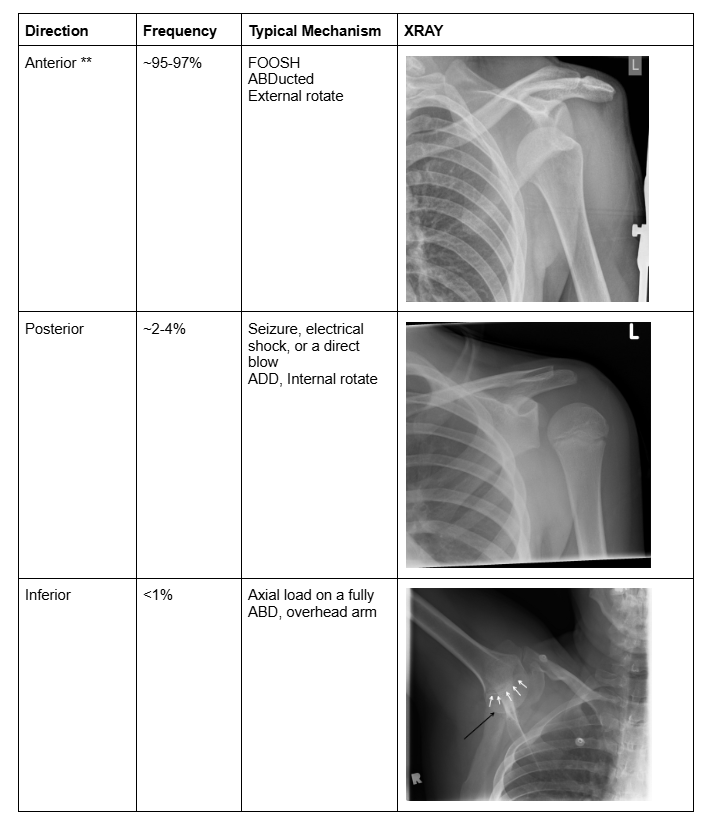
**Because anterior dislocations make up the overwhelming majority of what we see in the ED, the rest of this post focuses on closed reduction of anterior shoulder dislocations.
Pre-reduction Assessment Checklist
History - For every patient, ask about
Mechanism and timing of injury
First-time vs. recurrent dislocation
Prior shoulder surgery
Neurovascular Exam — before and after every attempt
Axillary nerve: sensation over the lateral deltoid, deltoid contraction
Radial, median, and ulnar nerve function
Distal pulses and capillary refill
Imaging
X-ray (AP + axillary or scapular-Y view) to confirm direction and rule out an associated fracture
Contraindication to worry about: a suspected associated fracture that needs orthopedic input before you pull on anything.
Analgesia & Procedural Sedation
Pain control is arguably the single biggest lever you have for first-pass success — a relaxed patient means relaxed muscles, and relaxed muscles mean the humeral head reduces more easily.
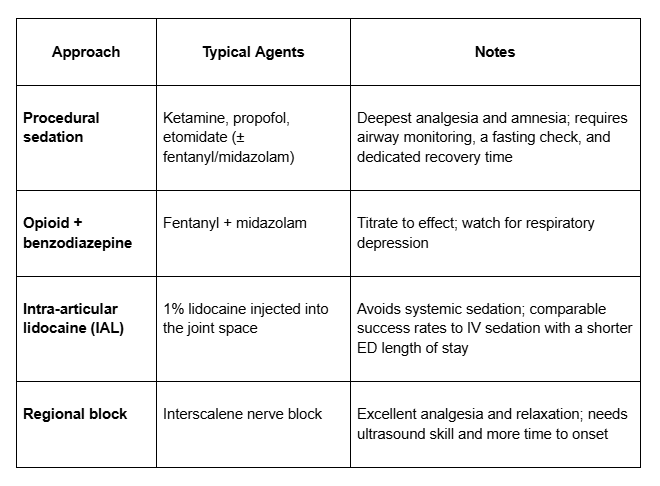
Five Closed Reduction Techniques
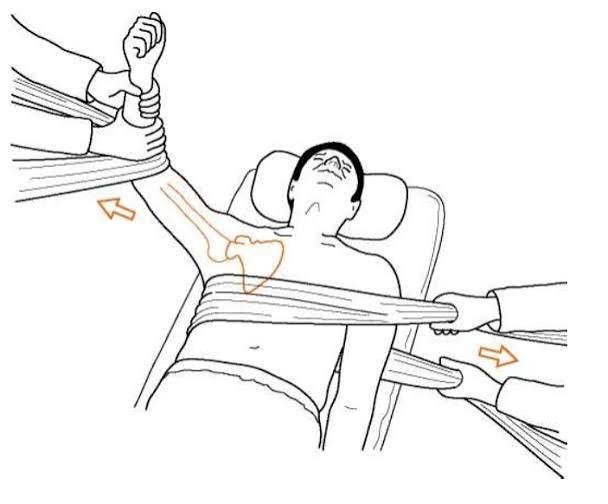
1. Traction–Countertraction
Apply folded sheet across patient’s chest/ axilla, anchor by an assistant for countertraction
Tie folded sheet around yourself
You apply steady, longitudinal traction at ~20-70 degrees of ABDuction
Maintain constant force for several minutes as muscles fatigue and relax
Massage glenohumeral joint to promote reduction
Wait for the clunk
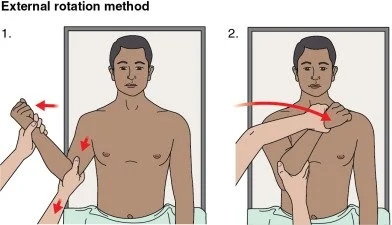
2. External Rotation
ADDuct arm, elbow flexed to 90deg
SLOWLY externally rotate forearm
Pause at resistance or spasm
Go past restrictive barrier
Reduction usually occurs before full rotation
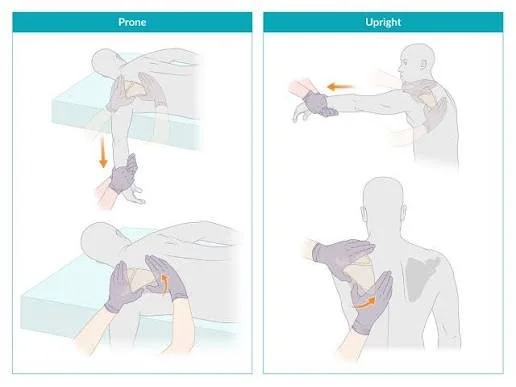
3. Scapular Manipulation
Stabilize scapula with one hand
Other hand rotates the inferior tip of scapula medially while stabilizing superior border
Rotate glenoid to re-engage with humeral head
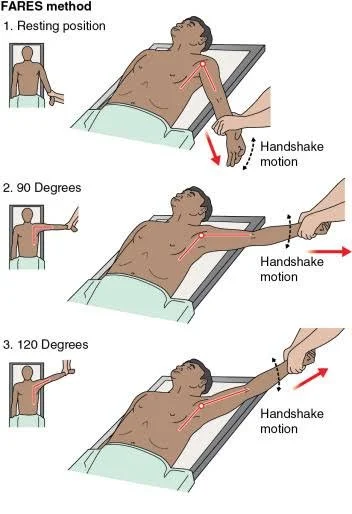
4. FARES Method
Apply longitudinal traction to extended arm
Gently oscillate arm up and down ~2-3 cycles per second (handshake motion)
Slowly ABDuct while oscillation
Continue past 90deg ABDuction
Bring into external reduction as reduction occurs
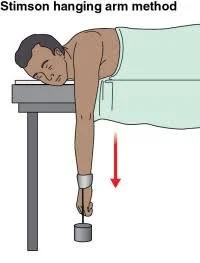
5. Stimson (gravity)
Attach 5-10lb weights to wrist
Gravity slowly fatigues and stretches shoulder, ~15-20 min
Reduction may happen spontaneously, or with gentle manual assistance
Post-reduction checklist
Repeat neurovascular and ROM exam
Post-reduction film
Immobilize
Take Home Points
Neurovascular exam pre AND post reduction are non-negotiable!! Document these!
Adequate analgesia improves first-pass success rate and patient comfort
No single method is best, you may combine methods if needed
Gentle, slow technique >> force
Pre and post X-rays are also non-negotiable!!
References
Alkaduhimi H, van der Linde JA, Willigenburg NW, et al. A systematic comparison of the closed shoulder reduction techniques. Arch Orthop Trauma Surg. 2017;137(5):589-599.
Sayegh FE, Kenanidis EI, Papavasiliou KA, et al. Reduction of acute anterior dislocations: a prospective randomized study comparing the FARES method with the Hippocratic and Kocher methods. J Bone Joint Surg Am. 2009;91(12):2775-2782.
Yuen MC, Yap PG, Chan YT, Tung WK. An easy method to reduce anterior shoulder dislocation: the Spaso technique. Emerg Med J. 2001;18(5):370-372.
Baykal B, Sener S, Turkan H. Scapular manipulation technique for reduction of traumatic anterior shoulder dislocations: experiences of an academic emergency department. Emerg Med J. 2005;22(5):336-338.
Anderson D, Zvirbulis R, Ciullo J. Scapular manipulation for reduction of anterior shoulder dislocations. Clin Orthop Relat Res. 1982;(164):181-183.
Sithamparapillai A, Grewal K, Thompson C, Walsh C, McLeod S. Intra-articular lidocaine versus intravenous sedation for closed reduction of acute anterior shoulder dislocation in the emergency department: a systematic review and meta-analysis. CJEM. 2022;24(8):809-819.
Ziang N, Hu YJ, Zhang KR, et al. Intra-articular lidocaine versus intravenous analgesia and sedation for manual closed reduction of acute anterior shoulder dislocation: an updated meta-analysis. J Clin Anesth. 2014;26(5):350-359.
Eachempati KK, Dua A, Malhotra R, et al. The external rotation method for reduction of acute anterior dislocations and fracture-dislocations of the shoulder. J Bone Joint Surg Am. 2004;86-A(11):2431-2434.
Medscape/eMedicine. Shoulder Dislocation: Practice Essentials, Epidemiology, and Treatment. emedicine.medscape.com/article/93323-overview.
Merck Manual Professional Edition. Shoulder Dislocations. merckmanuals.com/professional/injuries-poisoning/dislocations/shoulder-dislocations.
Baden DN, Roetman MH, Boeije T, et al. BRASD trial: biomechanical reposition techniques in anterior shoulder dislocation — a randomized multicenter clinical trial. Int J Emerg Med. 2023;16(1):14.
https://radiopaedia.org/articles/anterior-shoulder-dislocation?lang=us
https://radiopaedia.org/articles/posterior-shoulder-dislocation?lang=us
https://radiopaedia.org/articles/inferior-shoulder-dislocation?lang=us