
Hematoma Blocks in the ED
Written by: Justin Varias, DO; Edited by: Timothy Khowong, MD, MSEd
Introduction
Distal radius fractures are extremely common and account for approximately 1 out of 6 (17-18%) of all fractures that present to the emergency department. These fractures are generally very painful and require substantial analgesia in preparation for further management with either open reduction and internal fixation with orthopedic surgery, or closed reduction in the ED. When indicated, closed reductions are simple procedures that can be easily performed by ED physicians without the need for orthopedic consultation, making it great for community or low-resourced settings. Analgesia can be achieved with a variety of methods, namely procedural sedation and hematoma blocks. The purpose of both is to reduce pain sufficiently enough for the fracture to be reduced manually. While procedural sedation is an option, this process is resource-intensive, requiring additional staff, IV access, and continuous cardiac monitoring. It is also associated with inherent risks, such as airway compromise and adverse effects to medications. Hematoma blocks circumvent this issue by providing local anesthesia to the fracture site without the need for potent sedatives, making it suitable for pediatric and elderly populations.
What is a hematoma block?
Unlike a traditional nerve block, a hematoma block involves injection of local anesthetic directly into the hematoma between fractured bone fragments. As the medication diffuses through the site, it blocks periosteal and nociceptive pain fibers.
When should you perform a hematoma block?
Hematoma blocks are great for known fractures of the upper extremity including the humerus, ulna, and most commonly the radius. They can also be an option in certain ankle and tibial fractures of the lower extremities.
Indications for an appropriate hematoma block:
Closed fractures requiring reductions
Cooperative patient
Isolated extremity injury
Relative contraindications involve coagulopathies and/or the use of anticoagulant medications which can affect hematoma formation and carries the risk of excessive bleeding, compartment syndrome, or exsanguination. There are however a few absolute contraindications to performing a hematoma block, listed below:
Open fractures
Overlying infection
Local anesthetic allergies
Neurovascular compromise
Evidence: How does it compare to procedural sedation?
A meta analysis conducted by Tseng et al. (2018) consisting of 4 randomized controlled trials and 1 non-randomized controlled trial comparing the efficacy of hematoma blocks and procedural sedation revealed that hematoma blocks have comparable pain control to procedural sedation. The researchers analyzed published RCTs comparing the two analgesia methods during the reduction of distal radius fractures (DRFs) on pain control. The primary outcomes measured were the differences in pain with hematoma blocks versus procedural sedation during the reduction procedure using validated pain scales such as the Visual Analogue Scale (VAS), numeric pain rating scale, Wong-Baker FACES pain rating scale, or procedure behavior checklist (PBCL). Several secondary outcomes were also analyzed, including differences in pain severity, reduction failure, and adverse effects (nausea, vomiting, and respiratory distress). Tseng et al. found that there was a decreased post-reduction pain severity with hematoma blocks compared to procedural sedation, however no difference was measured in pain severity during reduction. Adverse effects were mostly reported by adult patients who underwent procedural sedation, with no significant difference seen in the pediatric populations. There was also no significant difference in reduction failure between the two methods.
Risks and Benefits
Overall faster to perform
Risk of infection <1%
Possibility of local anesthetic systemic toxicity (LAST) is rare
No airway risk
No need for IV access and cardiac monitoring - important for high-volume or resource-limited EDs
Reduced ED length of stay by 30-90 minutes
How to do a hematoma block
Medication Options
Local anesthetics
Lidocaine 1% (most common)
Bupivacaine 0.25% for longer duration
Typical dosing
Lidocaine: 5–10 mL (max 4.5 mg/kg without epi)
Optional: buffer with bicarbonate (1:10)
Getting Started
Sterile or non-sterile gloves
Cleansing solution (chlorhexidine solution, or alcohol wipes)
10 cc syringe
Large bore needle to draw medications (18 gauge)
Needle for injection (20-22 gauge)
Small bore needle for wheal (25 gauge)
5-10 cc 1% or 2% lidocaine
± Ultrasound machine
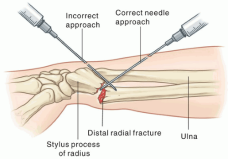
Technique 1: Landmark-based
Obtain x-rays to confirm a fracture
Identify fracture site by palpation
Prep skin with chlorhexidine
Inject superficially to create a wheal
Insert needle perpendicular to skin
Advance until bone contact
Aspirate blood and inject slowly
Remove needle
Wait 5–10 minutes before reduction
Consider the limitations for a landmark-based approach, such as patients with a large body habitus and complex fractures.
Technique 2: Ultrasound-guided
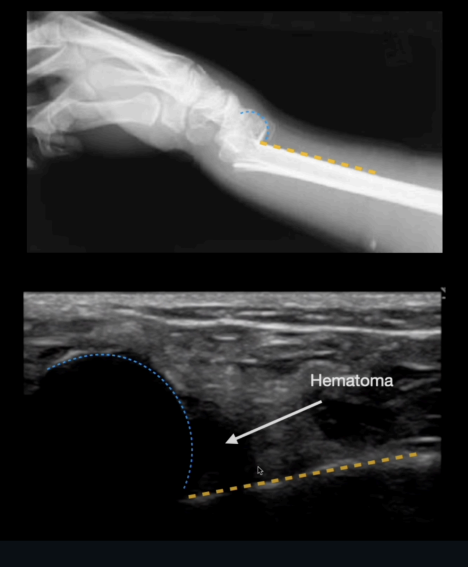
Ultrasound may be a useful adjunct for patients with difficult anatomy, however success is dependent on physician experience. A linear probe should be used for visualization of the hematoma. The image will show a cortical disruption of the bone at the fracture site in the long axis view, and there may be periosteal elevation surrounding the hematoma. It is important to note that the hematoma will appear hypoechoic without consistent internal blood flow on color doppler. Internal blood flow may indicate the presence of a pseudoaneurysm or AV fistula.
Obtain x-rays to confirm a fracture
Prep skin
Sterile probe cover + gel
Identify fracture hematoma
In-plane needle approach
Advance under direct visualization
Confirm needle tip within hematoma
Inject and observe spread
Hematoma should expand with anesthetic
References
Tseng PT, Leu TH, Chen YW, Chen YP. Hematoma block or procedural sedation and analgesia, which is the most effective method of anesthesia in reduction of displaced distal radius fracture?. J Orthop Surg Res. 2018;13(1):62. Published 2018 Mar 27.
https://epmonthly.com/article/hematoma-blocks-for-reduction-of-distal-radius-fractures/ ● https://wikem.org/wiki/Hematoma_block
https://coreultrasound.com/fracture-and-hematoma-blocks/
Gottlieb M, Cosby K. Ultrasound-guided hematoma block for distal radial and ulnar fractures. J Emerg Med. 2015;48(3):310-312.
Abbasi S, Garjani N, Mahshidfar B, et al. Comparative Study of Radial and Median Nerve Blocks with Hematoma Block under Ultrasound Guide in Distal Radius Fracture Reduction: A Randomized Clinical Trial. Med J Islam Repub Iran. 2023;37:113. Published 2023 Oct 23.