
The RAMER Reviews: Pulmonary Edema — Do They Really Need BiPAP?
Written By: Kirandeep Kaur, MD; Edited by: Brian Smith, DO, MA, MMSc-Med
Introduction:
The patient rolls into your ED sitting completely upright.
Respiratory rate: 34 SpO₂: 88% BP: 190/110
They are diaphoretic, using every accessory muscle they have, and the lung ultrasound looks like someone drew B-lines across the entire screen. You already know what you are reaching for: Nitroglycerin. Positive pressure. Fix the afterload.
But then the respiratory therapist asks: “Do you want BiPAP or high flow?”
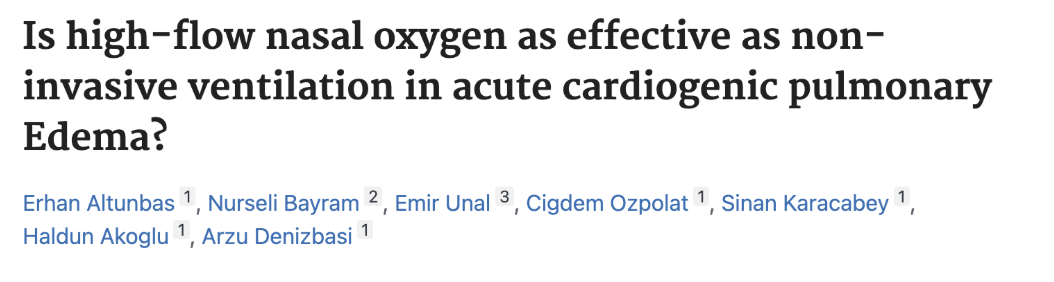
Most of us were taught that acute cardiogenic pulmonary edema belongs on non-invasive ventilation. But HFNC is easier to tolerate, lets patients talk and clear secretions, and requires less of the claustrophobic battle that sometimes comes with a tight-fitting NIV mask. So can we just use high flow? Altunbas et al. tried to answer that question.
What Did They Do?
This was a prospective randomized trial performed in a large academic emergency department in Turkey. The investigators screened 1,376 patients and randomized 178 with acute cardiogenic pulmonary edema to either HFNC or NIV. Patients were not mildly short of breath.
To get into the study, they had to have:
RR >24
SpO₂ <92% on room air
Increased work of breathing
Bilateral rales
Imaging or ultrasound evidence of pulmonary congestion
HFNC was initially run at 60 L/min. NIV was delivered by oronasal CPAP with 5–10 cm H₂O of PEEP. Everyone also received standard therapy, including IV diuretics and nitrates.
Their primary outcome was simple: How much did the respiratory rate improve after two hours?
And the winner was… basically a tie. Respiratory rate decreased by: HFNC: 8 breaths/min vs NIV: 7.7 breaths/min
Between-group difference: 0.37 breaths/min. 95% CI −0.71 to 1.46
That is neither statistically significant nor particularly clinically impressive as a difference. The two treatments also performed similarly for oxygenation, PCO₂, pH, lactate, blood pressure, dyspnea scores, and hospitalization. At first glance, it sounds simple: HFNC works just as well as NIV.
Not so fast.
The Statistical Trap
The authors describe this study as a superiority trial.
A superiority trial asks: Is Treatment A better than Treatment B?
If the answer is not statistically significant, all we can say is: We failed to demonstrate a difference.
That is not the same question as: Is Treatment A close enough to Treatment B that we can consider them equivalent? That requires a properly designed equivalence or noninferiority study with a prespecified margin for how much worse we are willing to accept.
This trial did not do that. So despite the title asking whether HFNC is “as effective,” the statistically correct conclusion is: HFNC was not shown to be superior or inferior to NIV for two-hour respiratory-rate improvement.
Who Wasn't in This Study?
This is probably even more important. The investigators excluded patients who:
Needed immediate intubation
Had MAP ≤65
Required vasopressors
Had GCS ≤13
Had STEMI
So this paper is not permission to put the crashing SCAPE patient on high flow and walk away. The study population was sick enough to need respiratory support but stable enough to participate in a two-hour noninvasive trial. Their median MAP was actually around 140 mm Hg.
How does this change my practice?
For a patient in severe respiratory distress from cardiogenic pulmonary edema, especially one who needs significant positive pressure: I'm still reaching for NIV.
But what about the 75-year-old who is awake, hypertensive, improving with nitrates, and repeatedly pulls off the CPAP mask because they cannot tolerate it? HFNC now feels like a much more defensible Plan B. Start it and treat the pulmonary edema aggressively and then reassess. The most important thing this study does not tell us is whether a patient who looks okay at two hours remains okay at six hours.
Bottom Line
HFNC and NIV produced very similar short-term improvements in respiratory rate, gas exchange, and dyspnea in selected, hemodynamically stable patients with acute cardiogenic pulmonary edema. However, a negative superiority trial does not prove equivalence. NIV remains my first choice in severe pulmonary edema. HFNC is a reasonable alternative for the right patient—especially when NIV isn't tolerated—but it should come with close reassessment and a low threshold to escalate.