
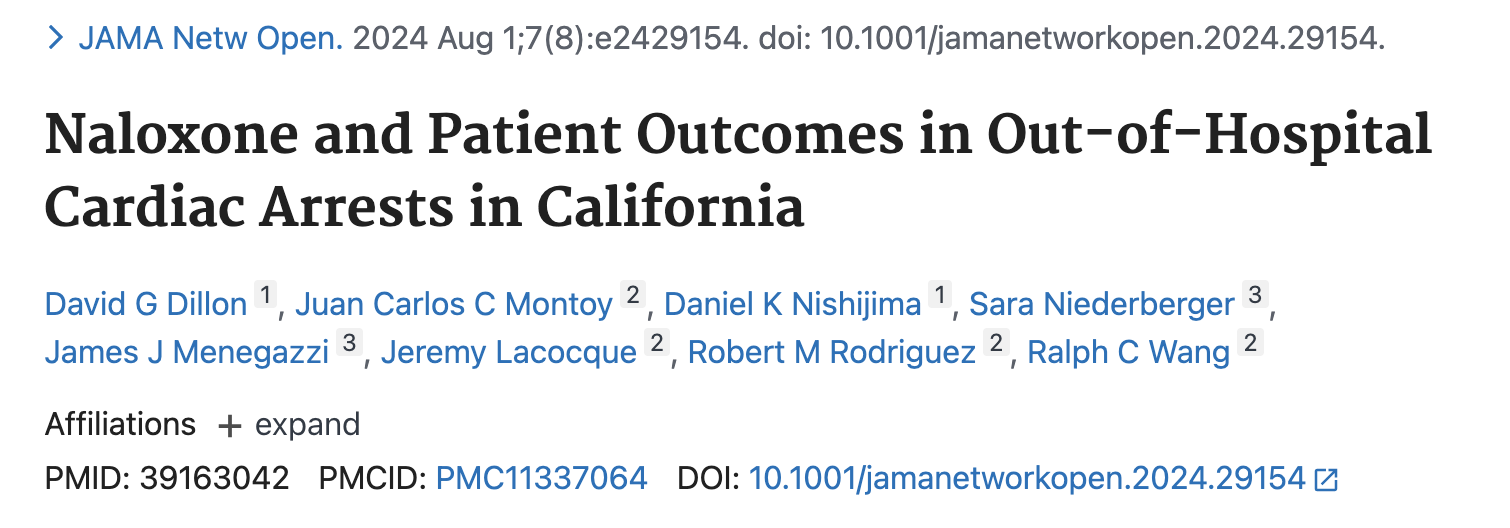
The RAMER Reviews: Naloxone and Patient Outcomes in Out-of-Hospital Cardiac Arrests in California
Written by: Jeffrey Chan, DO; Edited by: Brian Smith, DO, MA, MMSc-Med
1. What is the study question?
Is EMS administration of naloxone during out-of-hospital cardiac arrest (OHCA) associated with improved return of spontaneous circulation (ROSC) or survival to hospital discharge?
The team evaluated all undifferentiated OHCA in this retrospective study, rather than only known opioid-associated cardiac arrests.
2. What study design is used to answer the question?
This is an observational, retrospective cohort study. The investigators reviewed EMS and hospital records of patients with OHCA treated between 2015 and 2023 in three Northern California counties.
Because this is observational rather than randomized, it can demonstrate an association between naloxone administration and outcomes but cannot establish causation.
3. What is the exposure or intervention?
The exposure was prehospital EMS administration of naloxone. The exposed group received naloxone while the control group includes patients who did not receive naloxone throughout the prehospital care.
Naloxone administration was identified using the medication administration record.
4. What is the outcome (or disease) and how is it measured/defined?
There were two outcomes:
Primary outcome:
Survival to hospital discharge, defined as live discharge from the hospital.
Secondary outcome:
Sustained ROSC, defined as a detectable pulse for at least 20 minutes or until the end of EMS care.
5. How were participants selected or recruited?
This was a retrospective analysis of existing electronic medical records rather than prospective recruitment. The team collected 8,339 medical records of patients treated for nontraumatic cardiac arrest between 2015 and 2023 in the three Northern California Counties. After exclusions (patients less than 18 years old, or records that were missing data regarding the administration of medications were excluded). 8,195 patients/records were included.
Data came from EMS agencies in Sacramento, San Francisco, and Yolo counties and the Cardiac Arrest Registry to Enhance Survival (CARES).
6. Who was included in the study?
Patients were included if they:
Were ≥18 years old
Had nontraumatic OHCA identified by EMS or the hospital teams
Had resuscitation effort provided by clinicians
Were treated by EMS in the three participating Northern California counties between 2015 and 2023.
7. Who was excluded from the study?
Patients were excluded if they:
Were younger than 18 years old
Had missing data regarding medication administration.
A total of 122 were excluded for age criteria, and 22 for incomplete exposure data.
8. If randomization occurred, at what point did it occur?
Not applicable. There was no randomization because this was a retrospective observational cohort study. Naloxone administration was determined by treating EMS clinicians rather than randomly assigned.
9. What do the authors say about power/sample size? Is the power adequate?
The provided study text does not report a formal prospective power or sample-size calculation. However, the study included a relatively large cohort of 8,195 patients, including 1,165 patients who received naloxone.
The relatively large sample produced reasonably precise estimates, as demonstrated by the confidence intervals demonstrated in the paper. Therefore, the study appears to have had adequate statistical power.
10. Are the study groups’ characteristics comparable at baseline?
After reviewing the demographics, the answer is no. Patients who received naloxone differed substantially from those who did not. The naloxone group was:
Younger
More likely to be male
Less likely to have comorbidities
More likely to have presumed drug-related OHCA
More likely to have a nonshockable rhythm
More likely to have an unwitnessed arrest
The investigators attempted to address these differences to limit confounding using propensity-score matching and inverse probability-weighted regression.
11. What statistical tests/methods were used? Was intention-to-treat maintained?
The investigators used:
Logistic regression and mixed-effects regression
Absolute risk differences (ARDs)
Risk ratios (RR)
Odds ratios (OR)
Confidence intervals (CI)
Propensity-score matching
Inverse probability-weighted regression adjustment
Average treatment effect on the treated (ATET) analysis
Intention-to-treat: Not applicable. This was not a randomized clinical trial. Patients were analyzed according to whether they actually received naloxone.
12. What are the results of the study?
Among 8,195 patients, 1,165 (14.2%) received naloxone.
Naloxone was associated with 15.2% absolute increase in ROSC and an NNT of 9 for ROSC.
For the survival to hospital discharge outcome, naloxone was associated with 6.2% absolute increase in survival and an NNT of 26.
13. Are the results statistically significant?
Yes. For both ROSC and survival to hospital discharge outcomes, P < .001
14. Are the results clinically significant?
Yes.
NNT = 9 for ROSC
NNT = 26 for survival to hospital discharge.
However, because this was an observational study, the observed benefit cannot be assumed to be caused by naloxone. Residual confounding and selection bias could contribute to the association. The authors therefore state that interventional studies are needed before causality can be assigned.
15. What are the biases/limitations that could cause you to question the authors’ conclusions?
Selection bias/confounding:
EMS clinicians were more likely to administer naloxone to younger patients and patients suspected of having drug-related OHCA, and the patients may inherently have different survival rates.
Residual confounding:
Not all relevant confounders were available in EMS records.
Resuscitation bias:
Patients with prolonged, refractory cardiac arrest may receive additional medications later during resuscitation, adding to more confounding factors.
Misclassification of drug-related OHCA:
Drug-related status was based on EMS provider impression. Some occult drug-related arrests may have been incorrectly classified as non-drug-related.
Timing and route of naloxone administration were unavailable:
The investigators did not know when during resuscitation naloxone was administered. Studies have shown blood concentration of Naloxone is related to clinical outcome.
The study could not distinguish IV, IO, or intranasal administration.
Bystander/first-responder naloxone:
The researchers could not completely determine whether some naloxone was administered by bystanders or non-EMS first responders.
Geographic population
Only three Northern California counties were studied, limiting generalizability/external validity.
16. Which limitations/biases are unique to the study design, and how were they addressed?
Because this is a retrospective cohort study, the major design-specific concern is confounding and selection bias rather than randomization or loss to follow-up.
Selection bias was addressed by propensity-score matching and inverse probability weighting. Confound was limited by multivariable regression and propensity models. Differences between treatment groups (demographics) were addressed by 1:1 nearest-neighbor propensity matching. Lastly, treatment-effect differences were limited by ATET analysis. However, the authors explicitly acknowledge that full adjustment for all confounders was impossible.
17. Comment on the overall internal validity. Did the authors rule out chance, bias, and confounding?
The large sample size and statistically significant results with confidence intervals make chance less likely. The authors attempted to reduce selection bias through propensity matching, inverse probability weighting, and additional regression analyses. The results were relatively consistent across models. However, confounding is the major remaining concern. Although measured confounders were adjusted for, the authors acknowledge that they could not account for confounders not captured in EMS records.
18. Comment on external validity/generalizability. Would these results change your practice?
The study included adults with nontraumatic OHCA treated by EMS in only three Northern California counties. Although the population included both urban and suburban areas, the authors acknowledge that the single geographic region limits generalizability.
Would this change practice?
Based on this study alone, it would be premature to conclude. The study supports consideration and further investigation, but it does not establish causality. However, the absolute increase in positive outcomes and the NNTs look promising. Current AHA guidance does recommend that EMS clinicians consider naloxone for known or suspected opioid-associated OHCA (but not routine administration for all cardiac arrests).
19. How does this fit our current knowledge?
This study fits into an area where evidence has historically been limited. Opioid-associated OHCA has become increasingly common and current AHA guidance allows EMS clinicians to consider naloxone in suspected opioid-associated OHCA. However, there were no known randomized trials of naloxone in OA-OHCA at the time of this study, prior to 2024. The study adds observational evidence that naloxone administration is associated with improved ROSC and survival to hospital discharge, including among both presumed drug-related and non-drug-related OHCA.