
Hip Fractures in the Emergency Department
Written by: Daniel Ng, MD; Edited by: Timothy Khowong, MD, MSEd
Background: Epidemiology & Risk Factors
Hip fractures are one of the most significant injuries affecting older adults, particularly regarding both falls and osteoporosis. Each year, between 30 and 60 percent of community-dwelling older adults experience a fall, and nearly 90 percent of hip fractures are a result of falling from a standing position. Women are more likely to sustain these injuries because osteoporosis is more common among them, giving women a lifetime risk of about 17.5 percent compared with just 6 percent in men. On average, women experience hip fractures around age 77, most often involving the femoral neck, while men tend to fracture slightly earlier at age 72.
While the most significant risk factors are osteoporosis and falls, the picture is more complex. A low BMI < 22 raises the risk, whereas a higher BMI can actually be protective in women between 70 and 79 years of age. Age and sex both play important roles, with older women at the highest risk because of both bone density loss and longer life expectancy. Socioeconomic challenges can also make individuals more vulnerable, and medical conditions such as cardiovascular disease or endocrine disorders like diabetes and hyperthyroidism add to the burden. These conditions can become a source for fall mechanisms. Even medications can tip the scale. For example, medications like benzodiazepines, opioids, and antidepressants can increase a patient’s fall risk due to their side effects.
Hip Fractures vs. Mortality
Hip fractures in older adults are associated with a high mortality and morbidity rate. In population studies, one-year mortality after a hip fracture ranges from 20 to 30 percent overall, but this risk rises dramatically in vulnerable subgroups. Among nursing home residents, approximately one in three die within 180 days, and mortality is even higher in men, who have nearly double the risk compared with women. Patients aged 90 and older face poor outcomes due to frailty and limited physiologic reserve, and those with severe cognitive impairment experience higher complication rates, less participation in rehabilitation, and significantly worse survival.
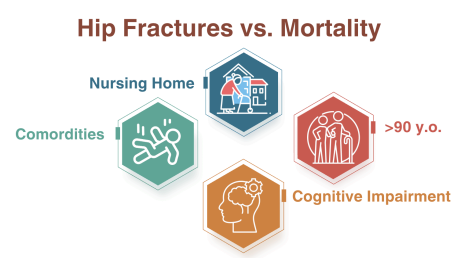
Additionally, the treatment approach also plays a role. While surgical repair within 24 to 72 hours is associated with better outcomes, nonoperative management carries an exceptionally poor prognosis, with short-term mortality exceeding 80 percent in some cohorts. Much of this risk stems from prolonged immobility, which leads to pneumonia, venous thromboembolism, urinary tract infections, pressure ulcers, and delirium.
Initial Management in the Emergency Department
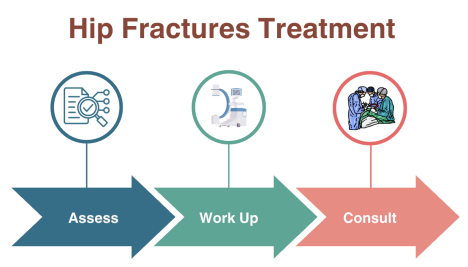
When an older adult presents to the emergency department with a suspected hip fracture, the first step is stabilization. This means applying our ABCs: airway, breathing, circulation, as well as securing IV access. Oftentimes, when a fall takes place, at triage, it is worthwhile to evaluate for cardiac and hypoglycemic etiologies with EKG and POC-glucose testing as these are inexpensive, convenient exams that can potentially identify an underlying reason for a fall.
Once the patient is stable, labs are obtained, including CBC to assess for anemia or bleeding, BMP or LFTs to evaluate metabolic and hepatic status, a coagulation profile to anticipate perioperative risk, and a type and screen in case transfusion is needed. Troponin and BNP are often added if there is concern for cardiac disease, but ordering this requires clinical suspicion for other etiologies beyond a mechanical fall. Typically, this should be correlated with detailed HPI reasoning, past medical history, and an undifferentiated patient with limited information that prompts for further investigation.
Imaging begins with a hip X-ray, but orthopedic teams frequently request views of the femur and knee to rule out concurrent fractures. Further imaging can be considered depending on the mechanism of the fall, clinical presentation, and physical examination (e.g. CT head w/o contrast).
If you are considering a future consult to orthopedic surgery with high likelihood for surgery, it may be worthwhile to consider other factors as well. For example, NPO status, fluid hydration, as well as delirium and pressure ulcer management, given that, as discussed above, the population that presents with these types of injuries is typically on the older side.
Lastly, pain management should be considered a top priority when it comes to our initial management. See below for further discussion.
Pain Management in the Emergency Department
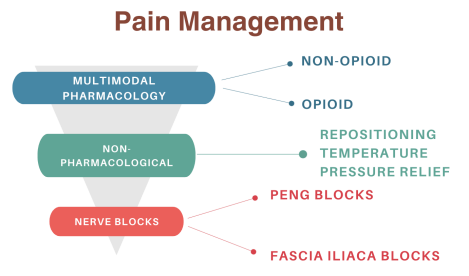
Effective pain management for older patients with hip fractures relies on a multimodal approach, typically combining acetaminophen, NSAIDs, opioids, and, when appropriate, nerve blocks. Pain is often undertreated in this population (see below for statistical data), which can hinder functional recovery, increase the risk of delirium, prolong hospitalization, and contribute to chronic pain development. Nonpharmacological strategies such as repositioning, pressure-relief devices, and cold therapy are commonly used. Preoperative nerve block options include those targeting the femoral nerve, such as femoral nerve blocks (less common), fascia iliaca blocks, or pericapsular nerve group (PENG) blocks. Continuous blocks are particularly valuable when surgical repair is delayed, as single-injection blocks generally provide relief for only 16–20 hours.
Undertreating Pain in the Emergency Department
Unfortunately, pain management for older adults with hip fractures in the emergency department is often suboptimal. Studies show that roughly 36% of patients receive no analgesia at all, and when treatment is given, it is frequently delayed, averaging 141 minutes from arrival, with 122 minutes after initial assessment. Patients with cognitive impairment are disproportionately affected, with only 60% receiving pain medication compared to 79% of cognitively intact patients, and they tend to receive lower median doses. Documentation gaps are common, with 34% lacking objective pain assessments, and in some cohorts, only 60% had any analgesic orders. Early pain scoring occurs in just 41% of patients within 30 minutes, while nerve blocks are utilized in about 45% of cases, highlighting opportunities to improve timely and adequate pain control in the emergency department.
The Importance of Nerve Blocks in the Elderly Population
Nerve blocks play a critical role in managing pain for the elderly population, particularly following hip fractures, because older adults have altered pharmacokinetics and heightened sensitivity to systemic analgesics. Aging reduces drug metabolism and clearance, meaning even small doses of opioids can produce pronounced effects such as sedation and respiratory depression. Polypharmacy and multiple comorbidities further increase these risks. Opioid use in this population is associated with a higher likelihood of delirium, which independently predicts poorer functional recovery, higher rates of institutionalization, and increased mortality. Frail older adults also have reduced physiologic reserve, making them more susceptible to falls, additional fractures, and loss of independence when exposed to sedating medications. Prolonged opioid use after hip fracture is common and linked to adverse long-term outcomes, yet older adults often face missed opportunities for treatment of opioid use disorder or access to naloxone, placing them at higher risk of morbidity and mortality. Nerve blocks provide a targeted, opioid-sparing alternative that minimizes systemic complications, supports functional recovery, and reduces the cascade of risks associated with traditional analgesics in this vulnerable population.
Nerve Block Options: PENG vs. FINB
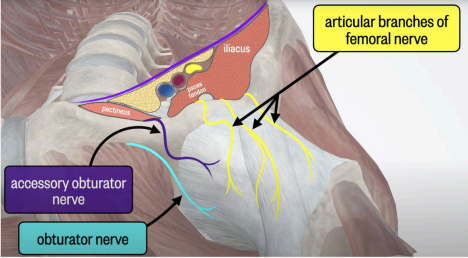
The pericapsular nerve group (PENG) block and the fascia iliaca nerve block (FINB) are both regional anesthesia techniques used for hip fracture pain, but they differ in target, coverage, and clinical effect. The PENG block specifically targets the articular branches of the femoral, obturator, and accessory obturator nerves that innervate the anterior hip capsule, providing focused analgesia with minimal motor weakness, which facilitates early mobilization. The FINB provides broader coverage of the femoral, lateral femoral cutaneous, and sometimes obturator nerves, offering more generalized analgesia but with a higher likelihood of quadriceps weakness. While FINB has been traditionally used for preoperative hip fracture pain, the PENG block is increasingly favored for proximal femur or acetabular fractures where preserving motor function is important. Both can be integrated into multimodal analgesia strategies to optimize pain control in older adults.
PENG Block Steps
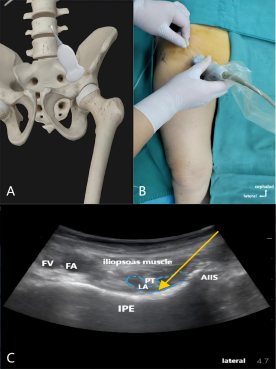
Patient positioning: Place the patient supine with the hip slightly flexed and externally rotated to optimize ultrasound visualization.
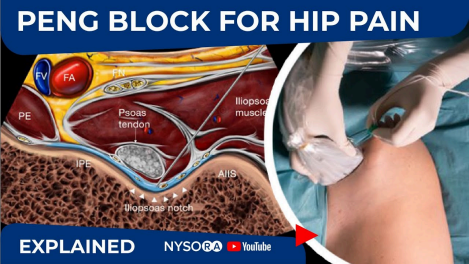
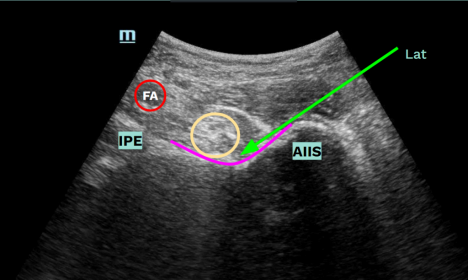
Ultrasound preparation: Use a low-frequency curvilinear probe in a transverse orientation over the anterior inferior iliac spine (AIIS) and move medially to identify the iliopubic eminence, femoral artery, and iliopsoas muscle.
Identify target plane: Locate the fascial plane between the psoas tendon and the pubic ramus, which contains the articular branches of the femoral, obturator, and accessory obturator nerves.
Aseptic preparation: Clean the skin thoroughly and maintain sterile technique.
Needle insertion: Using an in-plane approach, insert a 22–25 gauge block needle from lateral to medial under continuous ultrasound guidance toward the fascial plane.
Aspiration: Carefully aspirate to avoid intravascular injection.
Injection: Slowly inject 15–20 mL of 0.25–0.5% ropivacaine or bupivacaine while observing hydrodissection in the fascial plane, ensuring the psoas tendon lifts off the pubic ramus.
Confirmation: Confirm adequate spread of local anesthetic along the fascial plane for effective analgesia of the anterior hip capsule while preserving quadriceps motor function.
References:
Bentler SE, Liu L, Obrizan M, Cook EA, Wright KB, Geweke JF, Chrischilles EA, Pavlik CE, Wallace RB, Ohsfeldt RL, Jones MP, Rosenthal GE, Wolinsky FD. The aftermath of hip fracture: discharge placement, functional status change, and mortality. Am J Epidemiol. 2009 Nov 15;170(10):1290-9. doi: 10.1093/aje/kwp266. Epub 2009 Oct 4. PMID: 19808632; PMCID: PMC2781759.
Walter N, Szymski D, Kurtz S, Alt V, Lowenberg DW, Lau E, Rupp M. Factors associated with mortality after proximal femoral fracture. J Orthop Traumatol. 2023 Jun 26;24(1):31. doi: 10.1186/s10195-023-00715-5. PMID: 37365418; PMCID: PMC10293507.
Lunde A, Tell GS, Pedersen AB, Scheike TH, Apalset EM, Ehrenstein V, Sørensen HT. The Role of Comorbidity in Mortality After Hip Fracture: A Nationwide Norwegian Study of 38,126 Women With Hip Fracture Matched to a General-Population Comparison Cohort. Am J Epidemiol. 2019 Feb 1;188(2):398-407. doi: 10.1093/aje/kwy251. PMID: 30407488; PMCID: PMC6357811.
Mariconda M, Costa GG, Cerbasi S, Recano P, Aitanti E, Gambacorta M, Misasi M. The determinants of mortality and morbidity during the year following fracture of the hip: a prospective study. Bone Joint J. 2015 Mar;97-B(3):383-90. doi: 10.1302/0301-620X.97B3.34504. PMID: 25737523.
Neuman MD, Silber JH, Magaziner JS, Passarella MA, Mehta S, Werner RM. Survival and functional outcomes after hip fracture among nursing home residents. JAMA Intern Med. 2014 Aug;174(8):1273-80. doi: 10.1001/jamainternmed.2014.2362. PMID: 25055155; PMCID: PMC412262
Bhandari M, Swiontkowski M. Management of Acute Hip Fracture. N Engl J Med. 2017 Nov 23;377(21):2053-2062. doi: 10.1056/NEJMcp1611090. PMID: 29166235.
Simunovic N, Devereaux PJ, Sprague S, Guyatt GH, Schemitsch E, Debeer J, Bhandari M. Effect of early surgery after hip fracture on mortality and complications: systematic review and meta-analysis. CMAJ. 2010 Oct 19;182(15):1609-16. doi: 10.1503/cmaj.092220. Epub 2010 Sep 13. PMID: 20837683; PMCID: PMC2952007.
Stone JM, Pujari A, Garlich J, Lin C. A Retrospective Cohort Study on Chronic Opioid Use After Geriatric Hip Fracture Surgery-Risk Factors, Trends, and Outcomes. J Am Acad Orthop Surg. 2023 Mar 15;31(6):312-318. doi: 10.5435/JAAOS-D-22-00458. Epub 2023 Jan 2. PMID: 36595589.
Snapp C, Byrd B, Porter M. Reduction of Postoperative Delirium and Opioid Use in Hip Fracture Patients Through Utilization of Emergency Department Physician Administered Regional Nerve Blocks. Geriatr Orthop Surg Rehabil. 2024 Jan 19;15:21514593241228073. doi: 10.1177/21514593241228073. PMID: 38250320; PMCID: PMC10799594.
Salkar M, Ramachandran S, Bentley JP, Eriator I, McGwin G, Twyner CC, Yang Y. Do Formulation and Dose of Long-Term Opioid Therapy Contribute to Risk of Adverse Events among Older Adults? J Gen Intern Med. 2022 Feb;37(2):367-374. doi: 10.1007/s11606-021-06792-8. Epub 2021 Jul 13. PMID: 34258726; PMCID: PMC8811113.