
Body Packers and Body Stuffers; Recognizing and Managing Concealed Drug Ingestions
Written By: Andrew Shanes, DO; Edited By: Brian Smith, DO, MA, MMSc-Med
Introduction
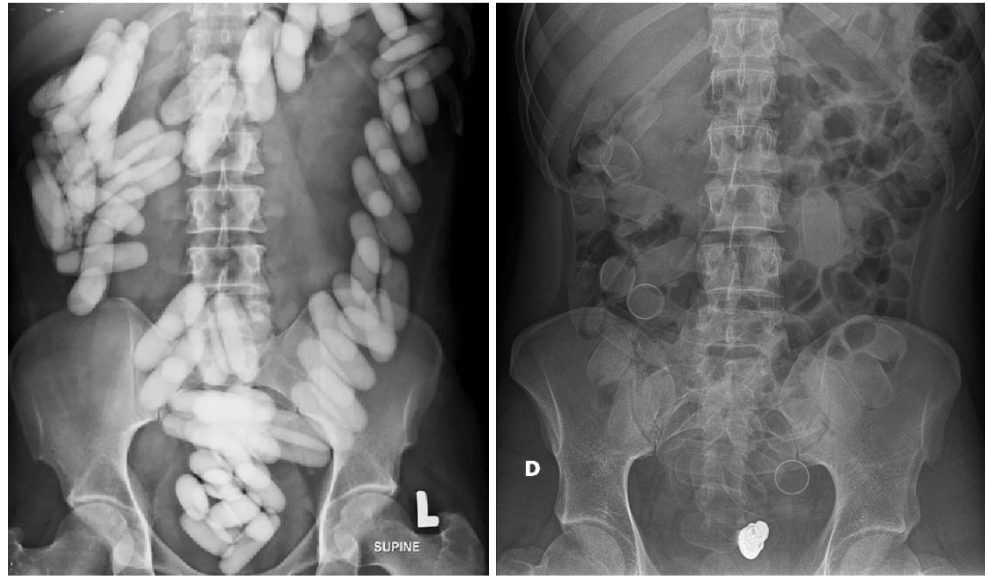
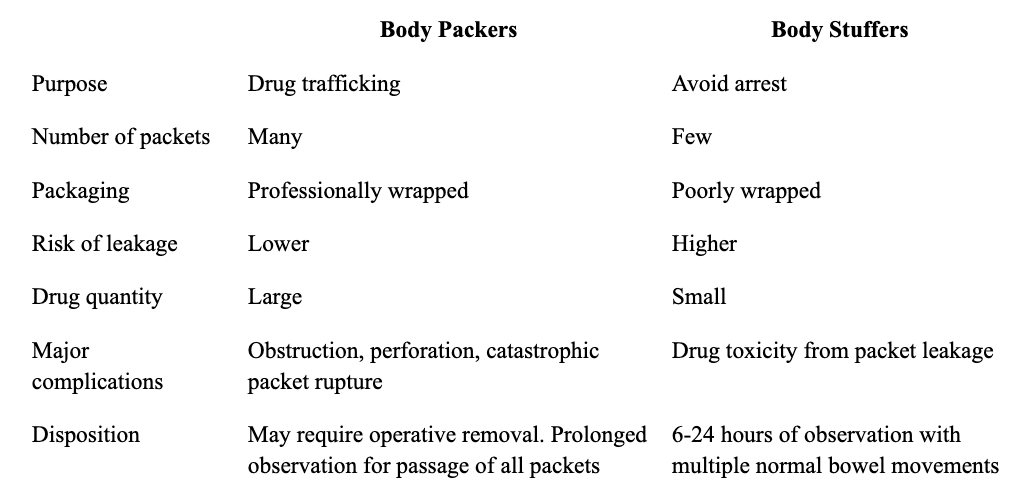
Emergency physicians may encounter patients who have intentionally concealed illicit drugs within their bodies. While the overall exact incidence of body packing presenting to the emergency department is rare and difficult to quantify, it becomes exceedingly important for providers to identify any patients who may be presenting for these reasons. While the terms body packing and body stuffing are often used interchangeably, they describe two very different clinical scenarios with distinct risks and management strategies. Recognizing the difference is essential, as body stuffers may only need observation, while body packers may rapidly deteriorate.
Body Packing
Body packing refers to the planned ingestion or insertion of well-packaged illicit drugs for the purpose of smuggling.
These individuals are commonly referred to as “drug mules.” These individuals may be victims of human trafficking, forced to swallow balloons containing illicit drugs and are then transported across borders. They are sometimes given anesthetic or an oily soup laced with drugs to numb their throats, allowing the balloons to slide down their throat easily. During the journey, they are given medication to inhibit bowel movement. Once they have reached their destination, they are fed laxatives and the balloons pass through their bodies.
One review analyzing 132 cases in one emergency department over a 12 year period reported:
Average of 16 packets
Approximately 1 kilogram of narcotics (100 packets) carried internally in extreme cases
Because the packaging is usually robust, many body packers remain asymptomatic, however a number of complications can develop.
Clinical Presentation
Most body packers present to the ED without significant symptoms. A majority of body packers remain asymptomatic altogether and will never come to the ED, however others may develop minimal symptoms including cramping, bloating, and generalized abdominal pain which they may seek help for. Some of these individuals coming to the ED will be accompanied by an individual keeping an eye on them, to prevent them from telling providers exactly why they may be there.
Although ingestion is the most common method of concealment, drugs may also be concealed in the rectum or vagina.
When more significant symptoms do occur, they generally result from:
1. Packet rupture
Each packet usually contains a lethal amount of drugs, most commonly cocaine, heroin, fentanyl, or methamphetamines. The toxicity depends on the substance. Ruptured cocaine packets will precipitate sympathomimetic toxicity, including tachydysrhythmias and local necrosis from vasoconstriction. Ruptured fentanyl packets can trigger euphoria and respiratory depression.
2. Mechanical complications
The packets themselves may cause obstruction in the GI tract, abdominal distension, and be a nidus for infection in the vagina or rectum. Profound electrolyte abnormalities may develop because drug mules are usually forced to use laxatives and purgatives to “increase capacity” before ingesting the packets and to avoid eating while transporting.
Diagnostic Evaluation
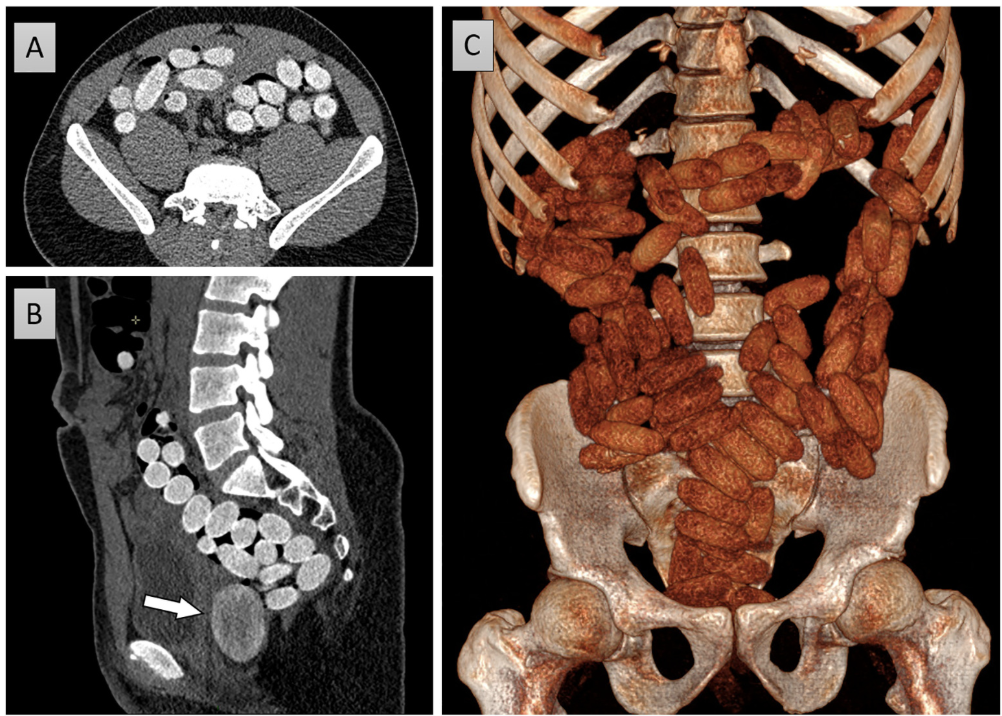
Abdominal radiography remains a useful screening tool. Large packet burdens can be detected with a reported sensitivity of approximately 85–90%, while the sensitivity diminishes as the quantity of packets decreases.
However, many emergency departments now favor CT abdomen/pelvis without contrast as the initial imaging study when suspicion is high, as it is reported to be 96%-100% sensitive and can better define obstruction or perforation.
Theoretically, computed tomography can also help differentiate between some drugs by analyzing differences in Hounsfield unit (HU) density. For example, opium has a density of 165-200 Hounsefeld Units, cocaine approximately 220 HU and heroin approximately 520 HU.
Routine laboratory studies and urine drug screens have limited value in asymptomatic patients. Laboratory evaluation should instead be by the patient's clinical presentation.
Management of Body Packers
Asymptomatic Patients
Management is generally conservative, focusing on symptomatic relief. Recommended considerations include:
Activated charcoal (1 g/kg) may be considered
Thought to have minimal effect/have no benefit as charcoal cannot penetrate packing materials
May be detrimental if contamination of the peritoneal cavity occurs after GI rupture or during surgery or if it obscures visualization should endoscopy become indicated.
Expectant management with close observation
Must consider the potential dose ingested, time since ingestion, and any therapies administered
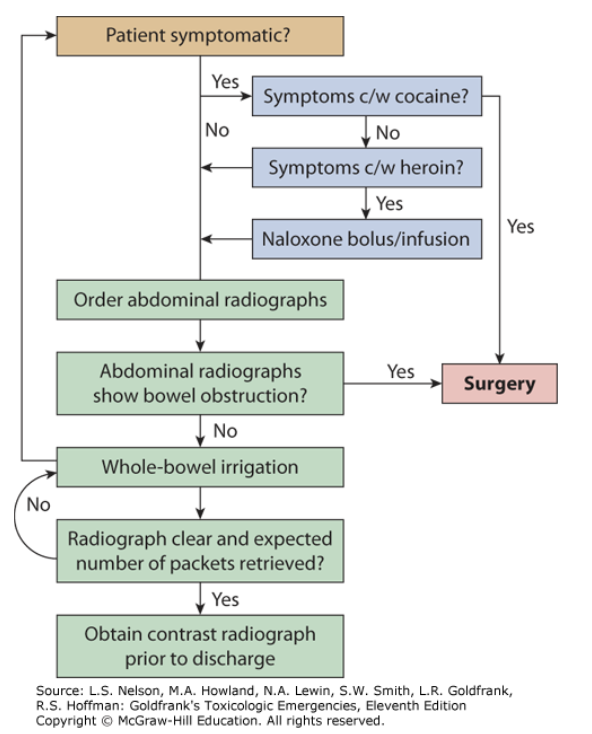
Whole bowel irrigation using polyethylene glycol solution (approximately 1-2 L/hour orally or via nasogastric tube) facilitates passage of packets
Observation should occur until the patient has several packet-free stools, a reliable packet count consistent with the ingestion and normal repeat imaging
Endoscopic removal is generally not recommended.
Manipulation increases the risk of packet rupture
Symptomatic Patients
Patients demonstrating toxicity or gastrointestinal complications require immediate stabilization with drug-specific supportive therapy. This may require intubation for airway protection for patients with opioid toxicity or benzodiazepines for stimulant toxicity.
Consult surgery if abdominal pain worsens or there is a sudden deterioration in clinical status suggestive of bowel obstruction or packet rupture.
Patients with a history of abdominal surgery appear to be at increased risk of obstruction. Individuals also carrying opioids also appear to be at higher risk of obstruction, due to microperforations or contamination of the outside of the packaging, leading to patients developing opioid-induced GI stasis.
Surgical intervention for packet removal should also be performed emergently in patients with any sign of cocaine or amphetamine toxicity including, but not limited to, hypertension, tachycardia, alteration in mental status (agitation), myocardial ischemia, bowel ischemia, seizures, respiratory distress as well as the transition of a urine drug screen result from negative to positive.
Body Stuffing
Body stuffing differs significantly from body packing. Rather than ingesting drugs for the purpose of transportation, body stuffers quickly swallow or hide small quantities of poorly wrapped drugs, usually to avoid detection by law enforcement whom they encounter unexpectedly.
These patients usually carry:
Fewer packets
Smaller drug quantities
Poorly packaged substances
Despite the smaller dose, the risk of packet leakage is higher because the packaging is often improvised (condom, plastic bag, plastic film, etc.).
Clinical Presentation
Body stuffers are more likely to become symptomatic because of increased risk of leakage through poor packaging. Urine drug screens may have more utility in body stuffers as patients with a history of using a certain substance are more likely to have “stuffed” a similar substance type, however these results should be interpreted with caution, as it is not guaranteed what they have ingested is the same substance their UDS will be positive for.
Management of Body Stuffers
Asymptomatic Patients
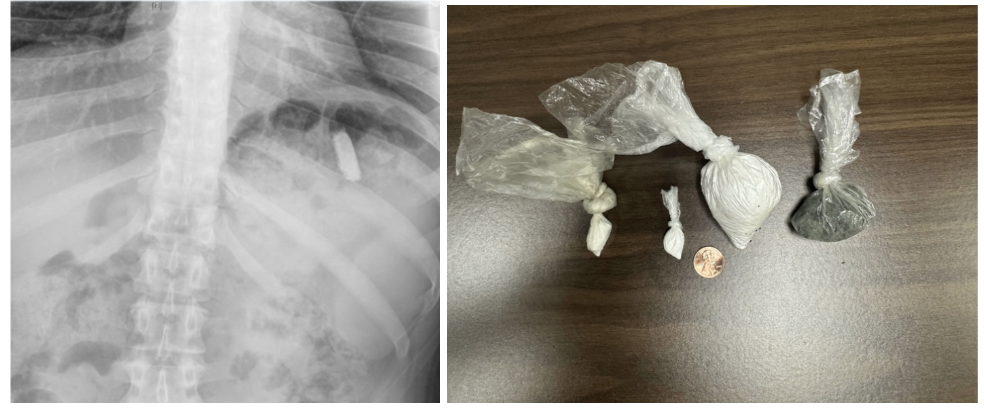
Management is largely supportive. Activated charcoal (1g/kg) may be recommended in awake/cooperative patients to reduce absorption as in these cases there is higher chance of penetration through packaging and higher chance of packaging becoming disrupted. However, these methods have not been proven to reduce morbidity or mortality and are only a theoretical benefit. It is also important to note that activated charcoal has not demonstrated benefit for methamphetamine or cocaine ingestion.
Whole bowel irrigation remains controversial as it has the potential risk to enhance the leakage and absorption of poorly wrapped packets, given the additional solvent being added, but may be appropriate when there is concern for a potentially lethal ingestion.
Symptomatic Patients
Similarly to body packers, treatment for symptomatic body stuffers focuses on stabilization, supportive care and surgical consultation when indicated. However, given lower quantities of drugs, symptomatic body stuffers do not have as high rates of severe toxicity.
Disposition
Most asymptomatic body stuffers can be safely discharged after approximately 6 hours of observation if they do not become symptomatic.
Patients suspected of ingesting larger, potentially lethal doses, should be observed for 24 hours, with confirmation of multiple normal bowel movements prior to discharge.
Summary
Key Takeaways
Body packers intentionally transport large quantities of well-packaged drugs and are at greatest risk for bowel obstruction and catastrophic toxicity if a packet ruptures.
Body stuffers swallow smaller quantities of poorly packaged drugs, making toxicity from leakage more common despite a lower overall amount of drugs.
Imaging plays a key role in evaluating suspected body packers, while laboratory testing has limited utility in asymptomatic patients.
Stable body packers often require observation and bowel decontamination, whereas symptomatic patients need aggressive resuscitation and consideration of early surgical involvement.
Most asymptomatic body stuffers can be safely discharged after a period of observation (approximately 6 hours) if they remain clinically well, though larger ingestions warrant longer monitoring.
References
Joshi, S. Hill, J. (September 13, 2022) Packers, Stuffers, and Pushers. TamingtheSRU. https://www.tamingthesru.com/blog/2022/9/12/packers-stuffers-and-pushers
Knipe H, Body packing. Reference article, Radiopaedia.org (Accessed on 27 Jul 2026) https://doi.org/10.53347/rID-26428
Mandava N, et al. Establishment of a definitive protocol for the diagnosis and management of body packers (drug mules). Emerg Med J.2011 Feb;28(2):98-101.
Nelson LS, Howland MA, Lewin NA, Smith SW, Goldfrank LR, Hoffman RS, eds. Goldfrank's Toxicologic Emergencies. 11th ed. McGraw-Hill Education; 2019.
Nogar J, Widmer S. Body Packers, Body Stuffers. In: Swadron S, Nordt S, and Mattu A, eds. CorePendium. 6th ed. Burbank, CA: CorePendium, LLC. https://www.emrap.org/corependium/chapter/recz0he8IPlduUXNR/Body-Packers-Body-Stuffers#h.zfa4klxacsq. Updated August 16, 2024. Accessed July 27, 2026.
Puntonet J, Gorgiard C, Soussy N et al. Body packing, body stuffing and body pushing: Characteristics and pitfalls on low-dose CT. Clinical Imaging, 2021; 79, 244-250
Shahnazi M, Sanei Taheri M, Pourghorban R. Body packing and its radiologic manifestations: a review article. Iran J Radiol. 2011 Dec;8(4):205-10. doi: 10.5812/iranjradiol.4757. Epub 2011 Dec 25. PMID: 23329942; PMCID: PMC3522363.
Snow, Timothy E. “Treating the Convicted.” EMRA, 8 Oct. 2015, https://www.emra.org/emresident/article/treating-the-convicted/.
United Nations Office on Drugs and Crime. Drug Mules: Swallowed by the Illicit Drug Trade. Published October 2012. Accessed August 3, 2026. https://www.unodc.org/southasia/frontpage/2012/october/drug-mules_-swallowed-by-the-illicit-drug-trade.html.