
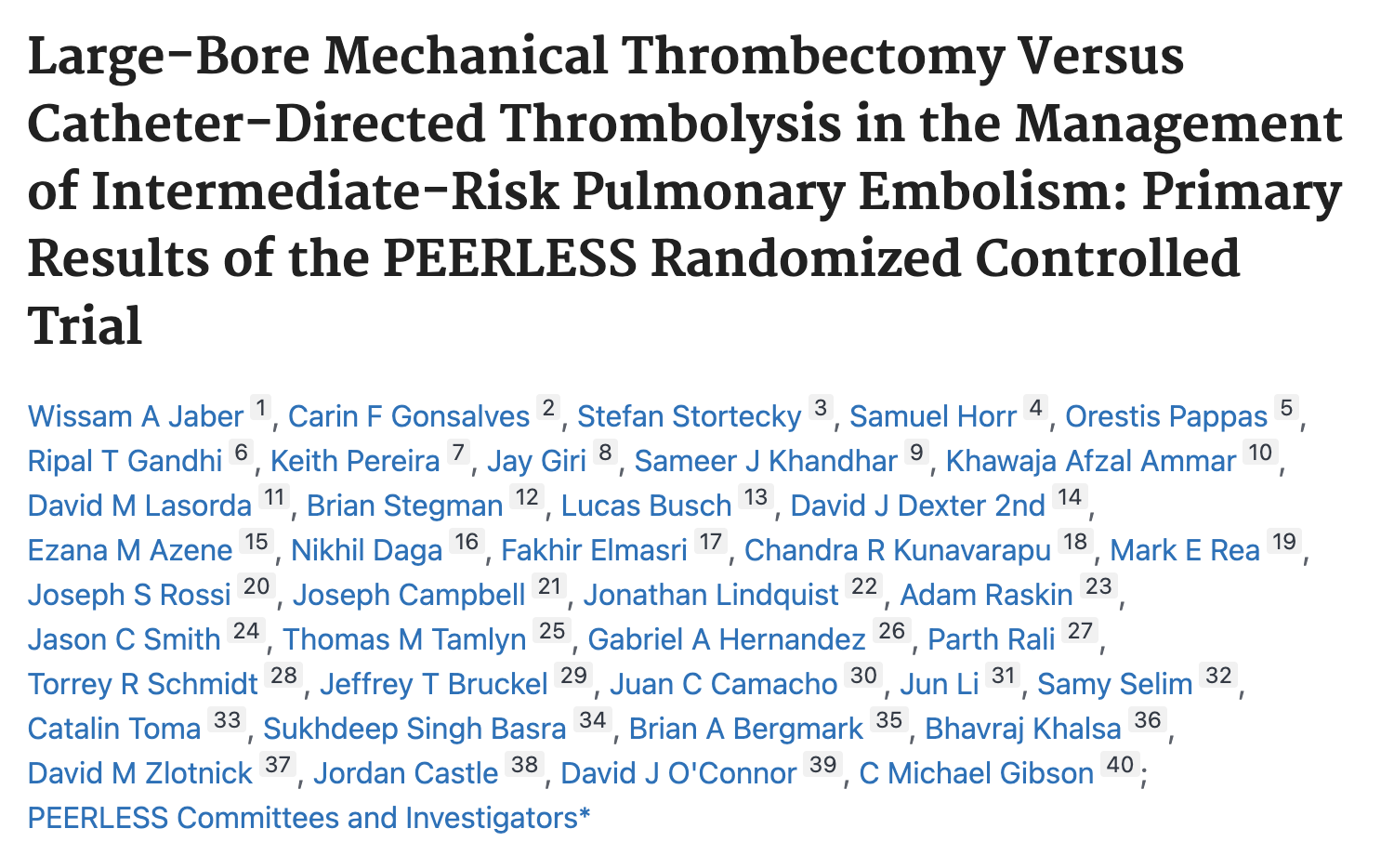
PEERLESS Trial: Does Mechanical Thrombectomy Beat Clot-Busting Drugs for intermediate-Risk PE?
Written By: Rita Kumar, DO; Edited By: Brian Smith, DO, MA, MMSc-Med
The Bottom Line
In patients with intermediate-risk (submassive) pulmonary embolism who are already selected for catheter-based intervention, large-bore mechanical thrombectomy (LBMT) using the FlowTriever system outperformed catheter-directed thrombolysis (CDT) on a composite primary endpoint — though much of that advantage was driven by differences in ICU utilization rather than hard clinical outcomes like death or major bleeding.
Background: Why Does This Matter?
Intermediate-risk PE — also called submassive PE — is a clinical gray zone. These patients aren't in shock, but they have right ventricular (RV) dysfunction and elevated troponins, putting them at real risk for rapid deterioration. Standard of care is anticoagulation, but select high-risk patients may warrant escalation to catheter-based therapies.
Two main interventional options exist: CDT (delivering low-dose thrombolytics directly into the clot via catheter) and LBMT (physically extracting thrombus with a large-bore device). Both have shown promise in observational studies, but until PEERLESS, no randomized trial had directly compared them head-to-head.
The Study Design
PEERLESS was a prospective, multicenter, international, open-label randomized controlled trial conducted across 60 sites. Key features:
550 patients randomized 1:1 to LBMT (FlowTriever) vs. CDT
Patients required: intermediate-risk PE by ESC criteria, RV dilation, proximal filling defect, and at least one additional risk factor (elevated troponin, tachycardia, hypotension, hypoxia, syncope, etc.)
Stratified by VTE-BLEED bleeding risk score
Follow-up at 24 hours, hospital discharge, and 30 days
Primary Endpoint: A hierarchical win ratio composite of five outcomes assessed through discharge or 7 days — in order of priority: all-cause mortality, intracranial hemorrhage (ICH), major bleeding, clinical deterioration or bailout therapy escalation, and post-procedural ICU admission and length of stay.
Key Results
Primary Endpoint:
LBMT won on the 5-component hierarchical win ratio: 5.01 (95% CI 3.68–6.97; P<0.001). On the surface, this looks like a decisive victory — but the devil is in the details.
What Actually Drove the Difference?
Only two of the five components showed a statistically significant difference:
ICU admission: 41.6% (LBMT) vs. 98.6% (CDT) — a massive and statistically significant gap driven largely by standard practice of admitting CDT patients to the ICU for monitoring.
Clinical deterioration/bailout: 1.8% (LBMT) vs. 5.4% (CDT); P=0.04
The Hard Outcomes Were Not Different
All-cause mortality: 0.0% vs. 0.4% — not significant
Intracranial hemorrhage: 0.7% vs. 0.4% — not significant
Major bleeding: 6.9% vs. 6.9% — identical
Critical nuance: When ICU outcomes were removed from the composite (the "4-component win ratio"), the difference between LBMT and CDT was no longer statistically significant (win ratio 1.34; 95% CI 0.78–2.35; P=0.30). This is the most important interpretive caveat of the entire trial.
Limitations to Keep in Mind
Open-label design: Both patients and clinicians knew which treatment was given, which is particularly problematic for subjective endpoints like clinical deterioration and ICU admission decisions.
ICU practice variation: Many centers routinely admit CDT patients to the ICU for infusion monitoring — a protocol-driven practice that inflated the ICU utilization difference and heavily influenced the primary win ratio.
CDT was not standardized: Device and thrombolytic dosing varied by site, while LBMT was standardized to one device (FlowTriever). This may have diluted CDT performance.
No anticoagulation-only arm: PEERLESS only compares two interventional strategies. It does not tell us whether either is better than anticoagulation alone — the current standard of care for most intermediate-risk PE patients.
Industry sponsorship: Inari Medical (maker of FlowTriever) co-designed the trial, which warrants critical scrutiny even with independent oversight.
Clinical Implications for Emergency Medicine
PEERLESS is a landmark trial as the first RCT to compare catheter-based PE interventions head-to-head — and that alone is worth celebrating. But the headline results require careful interpretation.
From an emergency medicine standpoint, our role is rarely to select between LBMT and CDT — that decision typically happens after the PE Response Team (PERT) activation.
What PEERLESS reinforces for us:
Early identification of intermediate-risk patients (RV dysfunction + troponin elevation) remains our critical contribution.
Systemic thrombolytics remain appropriate for true massive (high-risk) PE. PEERLESS does not change that calculus.
The question of whether any catheter-based strategy beats anticoagulation alone for intermediate-risk PE remains unanswered. Keep an eye on the HI-PEITHO and PE-TRACT trials.
Our Takeaway
PEERLESS is the first high-quality RCT to compare LBMT with CDT and demonstrates that mechanical thrombectomy is associated with less clinical deterioration and lower post-procedural ICU utilization. However, there was no difference in mortality, intracranial hemorrhage, or major bleeding. The primary outcome was largely driven by ICU practice patterns in an open-label trial — so interpret the win ratio accordingly. This trial advances our understanding of PE intervention options, but does not definitively establish LBMT as the superior strategy, nor does it address whether intervention is better than anticoagulation alone.